
Order 4 to 6 Weeks Early: Two Piece Prom Dresses That Fit, Dress Me Up NY
Order 4 to 6 Weeks Early: Two Piece Prom Dresses That Fit, Dress Me Up NY
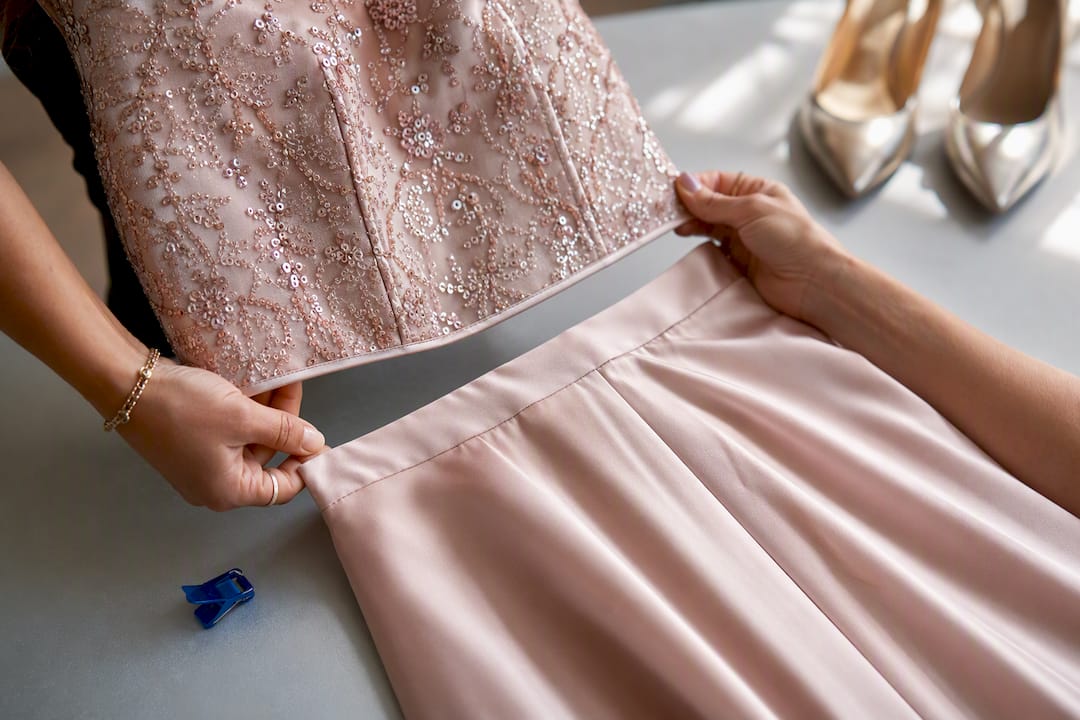
Two-piece prom dresses are coordinated top-and-skirt sets that let you mix coverage, texture, and silhouette into one custom-feeling look, rather than settling for whatever a single gown offers. Before you fall for a photo online, check four things: how the top and skirt sizes fit your actual measurements, what the fabric does when you move, whether the length matches your prom’s vibe, and whether you have enough time left for alterations and returns.
TL;DR:
- Proper measurements for bust, waist, and hips are necessary for each piece, as sizing differs between the top and skirt of a two-piece dress.
- Fabrics like satin and sequin can affect comfort and movement, with heavier embellishments weighing the dress and influencing how it hangs and travels.
- Length choices, such as floor-length or midi, depend on the prom’s formality and movement, with detachable overskirts and high-low styles offering flexible options.
- Alterations should be planned for both pieces separately, allowing extra time for fitting and tailoring at least three to four weeks before prom.
- Care instructions vary by fabric, with steam cleaning recommended for embellishments and proper packing essential for preventing snags and maintaining the dress’s condition.
Table of Contents
- What Are the Most Popular Two-Piece Prom Dress Styles?
- How to Choose the Right Fit and Size for a Two-Piece Prom Dress
- Fabrics and Embellishments: What Feels Good and What Photographs Well
- Long or Short: Which Two-Piece Length Fits Your Prom?
- How to Style a Two-Piece Prom Dress From Head to Toe
- Smart Shopping Checklist Before You Buy Online
- Dress Me Up NY’s Approach to Two-Piece Fit and Style
- Two-Piece vs. One-Piece Prom Dresses: The Real Trade-Offs
- Alteration Tips for Two-Piece Prom Dresses
- A Note From Dressmeup
- Shop Two-Piece Prom Dresses at Dress Me Up NY
- Sources
What Are the Most Popular Two-Piece Prom Dress Styles?
Every two-piece set is built from two decisions: what the top does and what the skirt does. Once you understand the main combinations, shopping gets a lot less overwhelming.
Crop-top and full skirt. This is the classic prom silhouette. A fitted or slightly structured top ends at or above the natural waist, and a voluminous skirt, often tulle or a satin ball-gown cut, takes over from there. It’s a forgiving combo because the skirt does the dramatic work while the top can be as simple or as beaded as you want. If you’re shorter on top and longer through the hips, this style balances proportions nicely.
Corset top and mermaid or fitted skirt. Corset-style tops with boning or structured seams create a defined waist, and pairing one with a slim mermaid skirt keeps the whole look sleek from shoulder to hem. This works well if you want a dress that hugs your natural shape. Just know that mermaid skirts restrict stride length, so factor in how much dancing you’re planning.
Sheath or midi two-piece sets. These skip drama in favor of a clean, column-like line, usually a fitted top paired with a straight or slightly flared midi skirt. It’s a strong pick for a more modern, less “pageant” prom aesthetic, and it photographs beautifully against simple backdrops.
Jacket or bolero over a slip dress. A cropped jacket, sometimes sheer, sometimes sequined, layers over a simpler underlayer dress. You get the two-piece look with more coverage up top, which appeals to anyone who wants a statement moment for photos but more ease once the jacket comes off for dancing.
Sequin or fully embellished sets. Some two-piece dresses go embellished top to bottom: a sequin crop top with a sequin or beaded skirt. These read as maximalist and work best for students who want to command attention on the dance floor under lights.
Catalog pages from specialist prom retailers consistently show these five families across dozens of colors and cuts, from jewel tones and metallics to classic black and white, which tells you the format itself has staying power, not just one trendy version of it.
A few fit cues to look for in product photos before you buy:
- Check where the waist seam sits on the model. A seam that hits above your natural waist will read as a higher crop on you if you’re taller than the model.
- Look at skirt volume relative to the model’s frame. A skirt that looks moderate on a size 2 model can look dramatically fuller on a size 14 body, in a good way, but you should expect it.
- Note whether the top has boning, a lining, or built-in support. That affects how forgiving it is if your bust size differs from the sample.
- Watch for illusion mesh at the midriff. It changes how much skin actually shows compared to what the photo suggests.
How to Choose the Right Fit and Size for a Two-Piece Prom Dress
Sizing a two-piece dress is really two separate sizing decisions happening at once, and treating them as one is the most common mistake shoppers make.
Start with four measurements: bust, underbust, natural waist, and hips. Bust and underbust determine your top size, especially for corset or fitted crop styles where a snug fit matters. Waist and hip measurements drive your skirt size, particularly for mermaid or fitted skirts where extra ease in the hips shows immediately. If your top size and skirt size land on different numbers on a brand’s chart, that’s normal, not a red flag, and it’s exactly why two-piece sets exist in the first place.
Here’s a simple process to follow before you check out:
- Measure yourself in the undergarments you’ll actually wear to prom, since bra padding and shapewear change your numbers.
- Compare your bust and underbust against the top’s size chart, and your waist and hips against the skirt’s chart separately.
- If you fall between two sizes on either piece, size up on the top and consider whether the skirt style has stretch or a lace-up back.
- Look for alteration-friendly details: adjustable straps, corset lacing, elastic waistbands, or hook-and-eye closures with extra room to take in or let out.
- Order early enough that a tailor has time to work if something needs adjusting.
That last point matters more than shoppers expect. Between shipping time, a first fitting, and a follow-up alteration appointment, you want at least three to four weeks of buffer before prom night. DressMeUpNY’s own guide to two-piece sizing walks through exactly this kind of separates-specific fit planning, and it’s worth a read before you commit to a size.
Pro Tip: If you’re between sizes on the skirt but the top fits perfectly, order the skirt one size up. Skirts are far easier and cheaper for a tailor to take in than to let out, and a too-tight waistband is miserable by hour three of a dance.
If you’re shopping plus-size, the fit math doesn’t change, but the margin for error does. A dedicated plus-size two-piece fit guide can help you spot which brands cut generously through the hip and which run narrow through the ribcage on corset styles.
Fabrics and Embellishments: What Feels Good and What Photographs Well
The fabric of your two-piece dress decides how it moves, how hot you’ll be by 10 p.m., and how it survives the car ride to prom. Knowing the basics before you shop saves you from a beautiful photo that turns into an uncomfortable night.
- Satin has structure and a natural sheen that photographs cleanly under flash, but it wrinkles and shows body heat more than other fabrics.
- Chiffon is lightweight and breathable, a smart choice for a full skirt you’ll be dancing in for hours.
- Tulle gives the most volume for the least weight, which is why it dominates full-skirt crop-top sets, though it can feel scratchy against bare skin without a soft lining.
- Jersey stretches and moves with your body, making it the most forgiving option for sheath and midi two-piece styles.
- Lace adds texture and a romantic finish, often layered over a lining for opacity, but it snags easily on jewelry and chair edges.
- Sequin mesh delivers maximum sparkle and reads well from a distance, though it’s heavier than it looks and can feel stiff against skin for hours-long wear.
Retailers like La Femme and Azazie show sequin, lace, and tulle two-piece combinations across nearly every color family, which is part of why the format has become a go-to for both formal and semi-formal proms.
Heavy beading and dense sequin work change more than the look; they change how the dress hangs, how much it weighs in a garment bag, and how it packs for travel. A fully sequined skirt can weigh noticeably more than its tulle counterpart, and that weight affects how it swings when you dance.
For care, steam rather than iron anything with sequins or beading, since direct heat can melt sequin backing or discolor thread. Dry cleaning is the safer default for satin and lace tops. When you transport the dress, hang the top and lay the skirt flat or roll it loosely with tissue paper between beaded layers to keep embellishments from snagging on each other. The Complete Guide to 2 Piece Formal Dresses goes deeper on matching fabric weight to your prom’s setting, indoor or outdoor, air-conditioned or not.
Long or Short: Which Two-Piece Length Fits Your Prom?
Length is really a question about how formal your prom feels and how much you plan to move. Neither option beats the other; they just serve different nights.
Choose a floor-length two-piece gown when:
- Your prom leans formal, with a sit-down dinner or a red-carpet-style entrance.
- You want dramatic photos with a skirt that pools and flows.
- You’re comfortable managing extra fabric while walking, dancing, and getting in and out of cars.
Choose a short or midi two-piece set when:
- Your event is more casual or energetic, with dancing as the main event.
- You want to move freely without worrying about hemlines or heels catching fabric.
- You’re aiming for a modern, less traditional prom look.
If you can’t decide, hybrid designs solve the problem well. Detachable overskirts let you take formal photos in a floor-length silhouette, then remove the overskirt for a shorter, dance-ready look later in the night. High-low hems split the difference permanently, giving you a dramatic back sweep with a shorter front hem for easier movement. Designer two-piece collections increasingly feature these detachable and high-low options specifically because students want both the photo moment and the freedom to dance afterward. For more on floor-length specifics, DressMeUpNY’s guide to long two-piece prom dresses covers skirt volume and train considerations in more depth.
How to Style a Two-Piece Prom Dress From Head to Toe
Styling a two-piece set comes down to reading what your dress is already saying and not fighting it. A heavily embellished top wants quiet accessories; a plain top can carry bolder pieces.
- Read your neckline and embellishment level first. If your top is beaded, sequined, or has a high embellishment density, keep jewelry minimal, small studs or a delicate bracelet. If your top is a simple satin or matte fabric, a statement necklace or bold earrings can carry the whole look.
- Match shoes to skirt volume and length. Full tulle skirts hide your shoes almost entirely, so comfort should win over showing them off; a block heel or platform gets you through hours of dancing without the ankle fatigue stilettos bring. Fitted mermaid or midi skirts show more shoe, so a strappy sandal or pointed pump earns its visibility.
- Choose a heel height you can actually dance in. Anything above three inches becomes a liability by the third slow song. A 2 to 2.5 inch block or wedge heel gives you the height without sacrificing your night.
- Plan hair and makeup around what skin the dress shows. Crop tops that reveal the midriff or an illusion-mesh back pair well with an updo, since it keeps the focus on the dress’s cutout details instead of competing with loose hair. A soft, defined eye look tends to balance a busier, more embellished top.
- Solve the clutch problem before prom night, not during it. Most two-piece skirts don’t have pockets, so a small clutch or crossbody with room for your phone, lip gloss, and a hotel-key-sized card holder saves you from awkwardly holding everything at dinner.
Smart Shopping Checklist Before You Buy Online
Two-piece prom dresses span a wide range of prices, and knowing roughly where you land helps you filter faster instead of scrolling endlessly.
- Entry-level sets tend to run in a lower budget band, often simpler fabrics like polyester satin or basic tulle with minimal beading.
- Mid-range sets usually add better fabric weight, more embellishment, or designer branding, landing in a moderate budget band.
- Premium sets bring heavier beadwork, structured boning, and finer fabrics like silk-blend satin, sitting at the top of the price spectrum. DressMeUpNY’s own floral two-piece collection prices its sets in a $450 to $550 range, with alterations typically running an additional $75 to $200, which gives a useful real-world anchor for what mid-to-premium two-piece pricing looks like.
Before you add anything to your cart, confirm the product page actually gives you what you need to buy confidently: a full measurement table for both pieces, listed model measurements so you can judge scale, real customer photos (not just studio shots), and clear text on shipping timelines, return windows, and care instructions. Category pages at large retailers like Macy’s filter by exactly these details, length, fabric, and style, because shoppers consistently need them to narrow decisions fast.
Build in lead time. Order at least four to six weeks out from prom to leave room for shipping delays and a tailor’s schedule.
Pro Tip: If a listing shows only one product photo, has no measurement table, or lists sizes as “small/medium/large” instead of numeric measurements, treat that as a red flag and keep scrolling. Separates without real measurement data are the single most common source of prom-night fit disasters.
Dress Me Up NY’s Approach to Two-Piece Fit and Style
Some retailers build their two-piece catalogs around the reality that separates require more fit attention than a single-piece gown, not less. That shows up in how their sites organize resources for shoppers working through this exact decision.
- A dedicated seven-tip guide to choosing two-piece prom dresses walks through fit, fabric, and timeline questions specific to separates.
- Style-specific guides cover white two-piece dresses, long gown silhouettes, and plus-size fit, reflecting the range of body types and vibes prom shoppers actually bring.
- Product pages are built around measurement tables and detailed fabric and care information, the same trust signals shoppers should expect from any specialist formalwear retailer.
Retailer support for fit questions is standard across the category, and shoppers should expect to be able to ask sizing questions before committing to a set, especially one that mixes a fitted top with a differently sized skirt.
Two-Piece vs. One-Piece Prom Dresses: The Real Trade-Offs
A two-piece set gives you flexibility a single gown can’t match. You can size the top and skirt independently, which solves the classic “great in the hips, too tight in the bust” problem that plagues one-piece shopping. You also get built-in outfit versatility. Some students wear the top alone later with jeans, or swap the skirt for a different occasion.
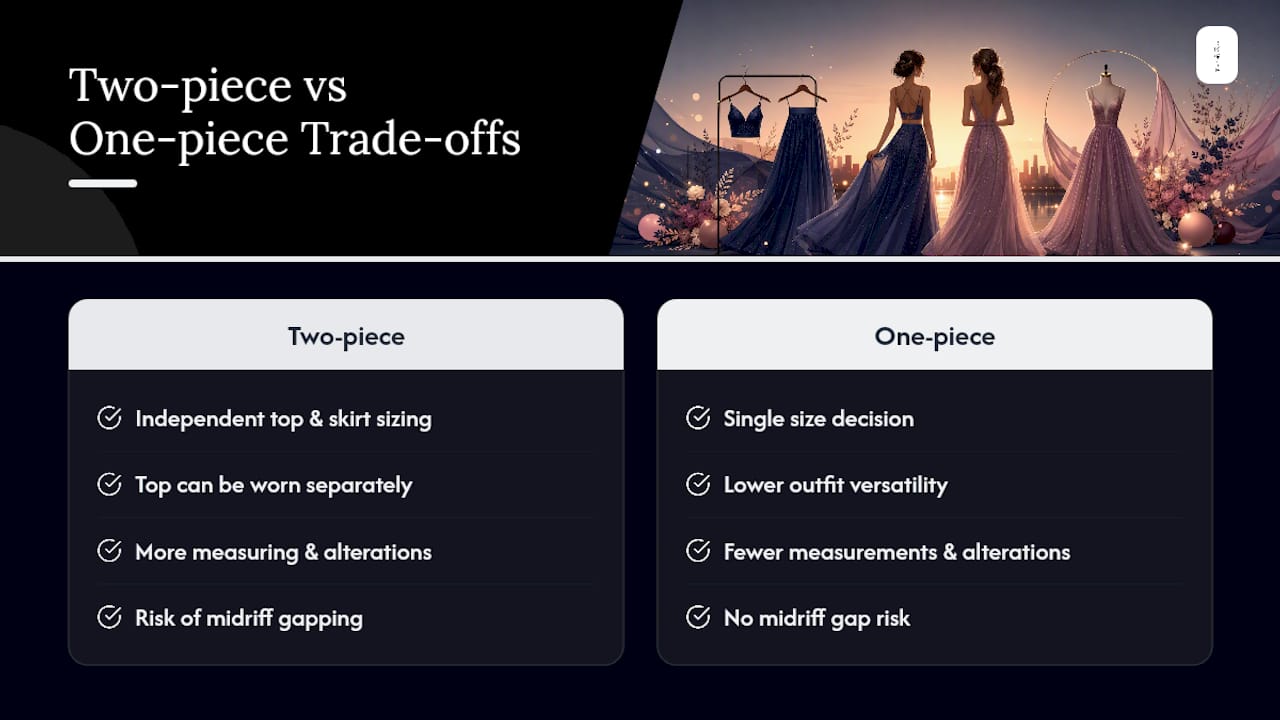
The trade-offs are real, though. Two separate pieces mean two separate fits to get right, which takes more measuring and sometimes more alterations than a single dress. There’s also a small risk of midriff gapping if the top rides up during dancing, something a one-piece gown never has to worry about. And matching two pieces means paying attention to whether the colors and fabrics actually coordinate, rather than trusting one continuous garment to look cohesive automatically.
One-piece gowns win on simplicity: one size decision, one silhouette, no midriff to manage. But they lose the customization that makes two-piece sets appealing to students who want a top that fits differently than their hips do. For most shoppers, the deciding factor isn’t which format is “better,” it’s whether your body proportions and personal style benefit more from mixing pieces or from one seamless line.
Alteration Tips for Two-Piece Prom Dresses
Because a two-piece dress is really two garments, alterations should be handled as two separate jobs, even if the same tailor does both.
Start with the top. Corset and crop tops usually need adjustments at the side seams or straps rather than the hem, since the goal is a snug fit through the bust and ribcage without restricting arm movement. If the top has lace-up or corset-style closures, a tailor can often achieve a custom fit without cutting fabric at all, which keeps future resale or resizing possible.
The skirt usually needs different work: hemming for length, taking in the waistband, or adjusting where the zipper sits relative to your natural waist. Mermaid and fitted skirts often need side-seam adjustments through the hip, while full tulle or ball-gown skirts more commonly need only a hem.
Bring both pieces to every fitting, even if only one needs work. Tailors need to see how the full look sits together, since a skirt hemmed without the top in the room can end up sitting at the wrong length once you’re wearing the complete set.
A Note From Dressmeup
The question we hear most from prom shoppers isn’t “which dress is prettiest.” It’s “how do I know this will actually fit before it arrives.” That’s a fair worry with any online purchase, but it’s a bigger one with two-piece dresses, since you’re really making two fit decisions at once instead of one.
Our honest take: the students who end up happiest with their two-piece dress are the ones who measure twice, order early, and treat the top and skirt as separate fit puzzles rather than assuming one size will handle both. Read the sizing guides before you buy, not after something doesn’t fit. It’s a small step that saves a lot of prom-week stress.
— Dressmeup
Shop Two-Piece Prom Dresses at Dress Me Up NY
Dressmeupny is built around exactly the kind of separates-specific decisions this guide walks through, with a curated two-piece collection organized by length, color, and embellishment level, backed by blog guides that go deeper into fit for coordinating a top and skirt.
If you’ve been piecing together fit advice from five different sites, you can shortcut that by starting directly with a retailer that treats two-piece sizing as its own category rather than an afterthought bolted onto one-piece gown charts. Every product page includes measurement details for both pieces so you can check the top and skirt against your own numbers before you buy, and the two-piece prom dress collection links out to the fit guides referenced throughout this article.
For fit concerns after your order arrives, review the site’s stated return and shipping windows so you know how much time you have to get to a tailor if adjustments are needed. Browse the current two-piece prom dresses collection to find your style, check the measurement table against your own numbers, and place your order with enough lead time for any alterations before prom night.
Recommended
- Dress Me Up NY’s 2 Piece Floral Prom Dresses: $450–$550 + $75–$200
- The Best Two-Piece White Prom Dress: Styles & Fit Guide
- Plus Size Prom Dresses: Curvy-Friendly Picks You’ll Love