
Corporate Formal Dress Code for Professional Women
Corporate Formal Dress Code for Professional Women
Corporate formal is the most conservative tier of professional attire, designed to signal authority and competence in high-stakes settings. Think of it as your power armor for the moments that count most. The simplest fail-safe outfit? A tailored navy sheath dress, a structured blazer, and closed-toe leather pumps. That combination, which Dressmeupny consistently recommends as a starting baseline, meets the standard at virtually every corporate formal occasion, from board presentations to senior-level interviews.
- Tailored navy sheath dress (at or below the knee)
- Structured blazer in matching or complementary neutral
- Closed-toe leather pumps in black or nude
- Minimal jewelry and a structured handbag
Pro Tip: If you are unsure whether an event calls for corporate formal, default to this outfit. Overdressing in a conservative direction almost never costs you credibility, but underdressing can.
Table of Contents
- What does corporate formal actually mean, and how is it different from black tie?
- When should you wear corporate formal?
- What garments make up a corporate formal wardrobe for women?
- Why does fit matter so much, and what are the tailoring rules?
- Which colors and fabrics work best for corporate formal?
- How do you complete a corporate formal look with accessories and grooming?
- What does a corporate formal shopping checklist look like, and what should you budget?
- How do you choose the right outfit for an interview or specific event?
- Ten ready-to-copy outfit formulas by role and season
- How Dressmeupny can help you shop for corporate formal
- Key Takeaways
- Corporate formal is a tool, not a uniform
- Useful sources for deeper guidance
What does corporate formal actually mean, and how is it different from black tie?
Corporate formal, often called business formal, is a professional, conservative dress standard used to project competence and authority at high-level corporate events. It is not eveningwear. Black tie belongs to social occasions like galas and charity dinners, where floor-length gowns and tuxedos are the norm. Corporate formal stays firmly in the professional lane: tailored, structured, and low on fashion risk.
Business casual sits at the other end of the spectrum. It allows blazer-free looks, relaxed trousers, and more color variety. Corporate formal allows none of that looseness. Every garment should be intentional, fitted, and polished.
Corporate formal is the standard that still dominates law firms, financial institutions, executive boardrooms, and any setting where external stakeholders set the tone. Post-pandemic, business casual became the daily norm for many offices, but business formal remains mandatory for high-stakes situations like board meetings and client-facing executive events.
Industries like finance, law, and consulting have held the line on formal standards even as tech and media companies loosened theirs. If you work in or visit those environments, corporate formal is not optional.
When should you wear corporate formal?
Not every meeting calls for a full formal look. Here is a quick decision guide:
- Board meetings and executive reviews — any room where C-suite or board members are present.
- Formal client presentations — especially first meetings with external clients in finance, law, or consulting.
- Senior-level job interviews — dressing one level above the company’s daily standard is the career-expert consensus for interviews.
- External legal proceedings — courtrooms, depositions, and arbitration hearings.
- Award ceremonies and formal company events — where leadership sets the visual tone.
The simplest decision rule: if leadership or external stakeholders are in the room, default to corporate formal. When in doubt, observe what client-facing senior staff wear, since HR policy sets the floor but leadership sets the real visual standard.
Geographic variation matters too. New York and Washington D.C. financial and legal firms tend to run more formal than West Coast tech-adjacent offices. When you are new to a company or industry, ask HR or watch the senior women in the room before dialing back.
What garments make up a corporate formal wardrobe for women?
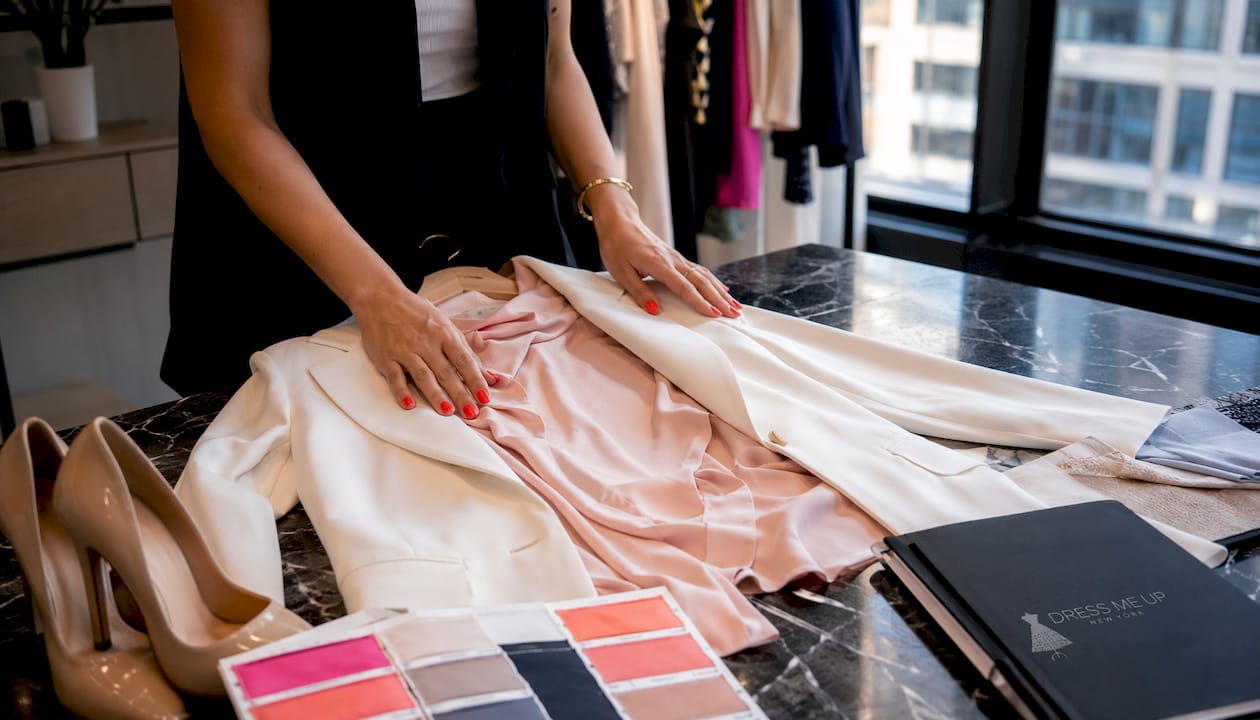
Corporate formal for women is built around a small set of structured, tailored pieces that mix and match easily:
- Tailored pantsuit in charcoal, navy, or black wool or gabardine
- Skirt suit with a pencil or A-line skirt at or below the knee
- Structured sheath dress in a neutral or deep tone, knee to midi length
- Blazer paired with tailored trousers in matching or tonal neutrals
- Silk or fine-cotton blouse with a modest collar (no deep V-necks or sheer fabrics)
- Midi wrap dress in crepe or ponte, in a solid conservative color
Business formal elements consistently include dark tailored suits, crisp blouses, and closed-toe leather shoes. The power of this wardrobe is in the mix-and-match potential: two blazers, two trousers, two sheath dresses, and three blouses can generate a week of distinct, polished outfits. Check out the latest formal dress trends for modern silhouettes that translate these classics into wearable 2026 options.
Why does fit matter so much, and what are the tailoring rules?
A $300 suit that fits perfectly reads more professional than a $1,000 suit that does not. Fit is the single biggest variable in how formal an outfit looks, and off-the-rack sizing rarely accounts for all proportions.
Start with shoulder seams and hem length. If the shoulder seams do not sit at the edge of your shoulder, the entire silhouette is compromised. Fix shoulders and hems before anything else.
Concrete fit checks to run before any event:
- Sit test: sit down fully and check that the hem stays at or below the knee, the blazer does not pull across the back, and the blouse does not gap at the bust.
- Walk test: take ten steps and confirm the skirt or trouser hem stays level and fabric does not bunch at the thighs.
- Lapel and shoulder check: lapels should lie flat, and shoulder seams should sit exactly at the shoulder point.
Common alteration priorities are hem length, waist suppression on blazers, and sleeve shortening. Plan for at least two weeks for standard alterations at most shops, and more during busy seasons like spring recruiting.
Pro Tip: Wear your formal shoes when you go for a fitting. Heel height changes the ideal hem length by a small but noticeable amount, and getting that wrong after alterations means starting over.
Which colors and fabrics work best for corporate formal?
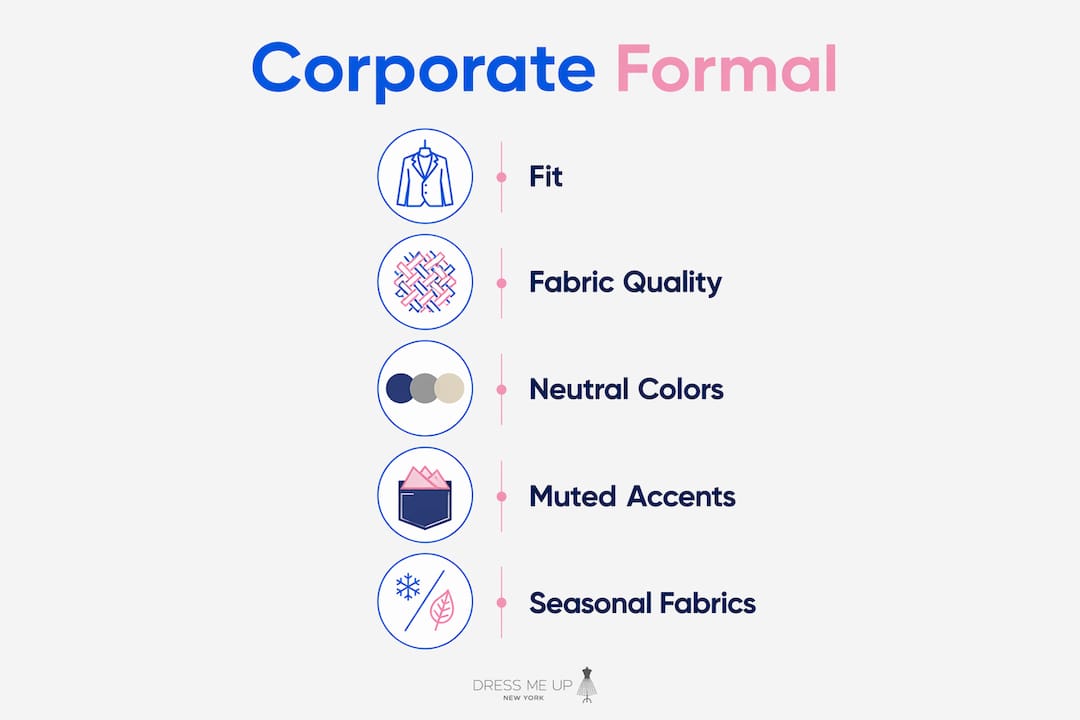
Color communicates before you say a word. The core corporate formal palette is navy, charcoal, black, cream, and deep neutrals like burgundy or forest green. These colors read authority without effort.
Fabric quality is what separates a polished corporate look from one that just looks expensive on a hanger. Wool, wool blends, crepe, and high-quality cotton hold their structure through a long day; shiny synthetics lose shape and catch light in ways that undermine the whole look.
Muted accents are acceptable. A blush silk blouse under a charcoal blazer, or a subtle herringbone pattern in a navy suit, adds personality without breaking the conservative standard. Loud prints, bright colors, and trendy patterns are the main things to avoid.
Seasonal fabric swaps keep you comfortable without sacrificing formality. Lightweight wool blends and ponte work year-round. Heavier wools and structured gabardine are better for fall and winter. In summer, breathable crepe and fine cotton keep you cool while maintaining the structured silhouette corporate formal requires.
Pro Tip: Hold fabric up to a window before buying. If it looks shiny or translucent, it will read cheap under office lighting regardless of the price tag.
How do you complete a corporate formal look with accessories and grooming?
Accessories in corporate formal follow one rule: support the outfit, do not compete with it. Here is the full checklist:
- Shoes: closed-toe pumps or structured block-heel shoes in leather; formal footwear guidance recommends a heel height of 2–3 inches for conservative settings, though polished dressy flats are equally appropriate.
- Bag: a structured handbag or leather tote in black, navy, or tan; avoid canvas, logo-heavy bags, or anything oversized.
- Jewelry: stud earrings, a simple pendant necklace, or a classic watch; skip statement pieces that draw the eye away from your face.
- Hair: pulled back or neatly styled; loose, undone waves read casual in formal settings.
- Makeup: polished and understated; neutral tones, defined brows, and a classic lip color work in every industry.
- Nails: neutral or classic red polish; avoid nail art or very long lengths in conservative industries.
- Hosiery: sheer nude or black hosiery is standard in law and finance; bare legs are generally acceptable in less conservative corporate settings.
For pairing advice specific to sheath and midi dresses, Dressmeupny’s guide on matching dresses with shoes walks through the combinations that work best by dress silhouette.
What does a corporate formal shopping checklist look like, and what should you budget?
Plan your purchase and alteration timeline carefully. Most people underestimate how long the full process takes.
Timeline to work backward from your event: order at least three to four weeks out to allow for shipping, a try-on, and a tailoring window. Alteration shops typically need at least two weeks for common adjustments. Rush alterations cost more and deliver worse results.
Also budget for hosiery, undergarments that smooth the silhouette, and a lint roller. These small items matter more than most people expect on the day.
How do you choose the right outfit for an interview or specific event?
Work through this five-step decision flow before every high-stakes occasion:
- Audience: who will be in the room? External clients and senior leadership call for full corporate formal.
- Location: a law firm or financial institution has stricter visual norms than a creative agency’s conference room.
- Time of day: morning and midday events skew more conservative; evening client dinners allow slightly more refined styling.
- Company culture: research the company’s LinkedIn photos and website imagery to gauge the real-world standard.
- Weather and season: plan for layers; a structured coat or blazer keeps the look polished from parking lot to boardroom.
For interviews specifically, dressing one level above the company’s daily norm signals seriousness and cultural awareness. If the office is business casual, you wear corporate formal. If the office is already formal, you wear your sharpest formal look.
Pro Tip: Wear your full interview outfit, including shoes and bag, for two to three hours at home the day before. Breaking in structured garments and shoes ahead of time eliminates the distraction of discomfort on the day that counts.
Ten ready-to-copy outfit formulas by role and season
- Junior associate interview (spring/fall): charcoal pantsuit + white silk blouse + black leather pumps + structured tote.
- Junior associate interview (summer): navy crepe sheath dress + white blazer + nude pumps + minimal gold studs.
- Director-level board meeting (fall/winter): black wool skirt suit + ivory blouse + black closed-toe heels + leather portfolio.
- Director-level board meeting (summer): navy ponte blazer + matching wide-leg trousers + silk shell + block-heel sandals with closed toe.
- Client dinner (evening): deep burgundy midi wrap dress in crepe + black structured blazer + black pointed-toe pumps.
- Legal proceeding: charcoal or black pantsuit + pale blue fine-cotton blouse + black leather oxfords or low pumps.
- Executive presentation (winter): camel wool blazer + black tailored trousers + cream blouse + black leather heels.
- Award ceremony (evening): midnight navy structured midi dress + matching blazer + metallic closed-toe heels.
- Spring transitional look: soft gray blazer + blush crepe trousers + white blouse + nude block heels.
- Client-facing role, any season: classic black sheath dress + structured blazer in any neutral + closed-toe pumps + pearl studs.
Each formula can be adapted by swapping the blouse color or blazer fabric while keeping the silhouette and formality intact. For gala-adjacent corporate events, Dressmeupny’s tips for elegant gala dresses offer additional selection guidance.
How Dressmeupny can help you shop for corporate formal
Dressmeupny specializes in women’s formal and special occasion dresses, with a catalog that covers sheath dresses, midi styles, and structured evening looks that translate directly into corporate formal territory. The blog covers practical topics like footwear pairing, ethical brand options, and trend-forward styling, so you can shop with context, not just browse.
Shopping for formal attire works best when you know your measurements before you click “add to cart.” Measure your bust, waist, and hips, then compare against the size chart for each garment. A dress that arrives in your size but needs no alterations is the exception, not the rule.
A few practical tips when shopping with Dressmeupny:
- Check the return and exchange policy before ordering, especially for event-specific purchases.
- If you want sustainable options, the ethical formal dress brands guide curates choices that align quality with values.
- Use the blog’s styling resources to match your dress to the right shoes and accessories before the order ships.
Browse Dressmeupny’s formal dress collection to find sheath dresses, midi styles, and structured looks that meet corporate formal standards without sacrificing personal style.
Key Takeaways
Corporate formal is a conservative, tailored wardrobe standard that requires fit, neutral color, and polished accessories to communicate authority in high-stakes professional settings.
| Point | Details |
|---|---|
| Fit before everything | Shoulder seams and hem length are the two alterations that most change how formal a garment reads. |
| Neutral palette wins | Navy, charcoal, black, and cream are the safest colors; muted accents are acceptable, loud prints are not. |
| Plan for tailoring time | Allow at least two weeks for alterations after your garment arrives, plus shipping time before that. |
| Dress one level up | For interviews and new environments, default to corporate formal even when the daily standard is business casual. |
| Break in your outfit | Wear your full look at home before the event to catch discomfort, fit issues, and hemline problems early. |
Corporate formal is a tool, not a uniform
Here is an honest take: the corporate formal dress code gets treated like a rigid rulebook, but it is really a communication strategy. The goal is to keep attention on your ideas and your presence, not your outfit. That means conservative choices are not about suppressing your style. They are about making sure your style never becomes the loudest thing in the room.
The women who navigate corporate formal most confidently are the ones who invest in fit and fabric quality, then add one quiet personal touch: a beautifully tailored blazer in a slightly unexpected shade, a silk blouse in a muted print, or a watch that means something to them. Those details read as intentional, not distracting.
If you are building your corporate formal wardrobe from scratch, start with two or three anchor pieces in neutral colors, get them tailored, and build from there. Chasing trends in this category almost always backfires. Timeless, well-fitted, and polished is the formula that holds up across every industry and every room.
Useful sources for deeper guidance
- Business Formal (Creighton University Career Center) — institutional definition separating business formal from black tie; a reliable starting point for understanding the standard.
- Attire Guide, Duke University Career Hub — covers fit testing, the sit-and-walk method, and the “dress one level up” rule for interviews.
- Professional Dress, University of Maine — practical shopping and alteration timeline guidance.
- Business Attire Guide, BlackTieAttire.org — tabular breakdown of formality levels from business formal to smart casual.
- Corporate Dress Codes 2026, ThriveMyWay — analysis of post-pandemic shifts and where formal standards still apply.
- What to Wear to a Formal Office, Dressy Lane — fabric and color guidance with seasonal considerations.
- Business Professional Attire, Glassdoor — break-in advice for shoes and structured garments before high-stakes events.
- Guide to Business Attire, Indeed — practical note on observing leadership as the fastest way to decode a company’s real formality standard.
- Professional Dress Codes, Virginia Tech Career Resources — reinforces the “dress one level above” strategy for career events and interviews.
- Dressmeupny Blog — styling guides covering footwear pairing, ethical brands, and formal dress trends for women.
Recommended
- Formal Evening Wear for Ladies: Style Rules That Matter - DressMeUpNY
- Dress Code Explained 2025: A Guide for Special Events - DressMeUpNY
- Types of Formal Dresses for Women: Style Choices That Impress - DressMeUpNY
- Master the formal chic dress code for special occasions - DressMeUpNY