
Evening Dress Alterations Near Me: Plan 1–3 Weeks Ahead for a Better Fit
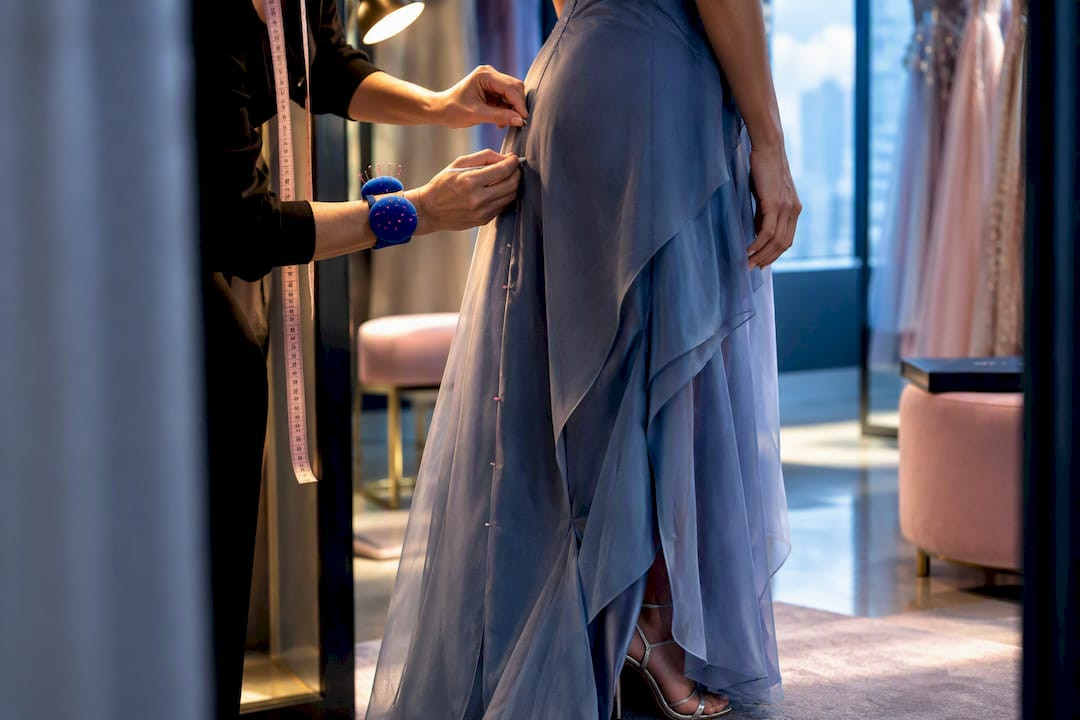
Evening Dress Alterations Near Me: Plan 1–3 Weeks Ahead for a Better Fit
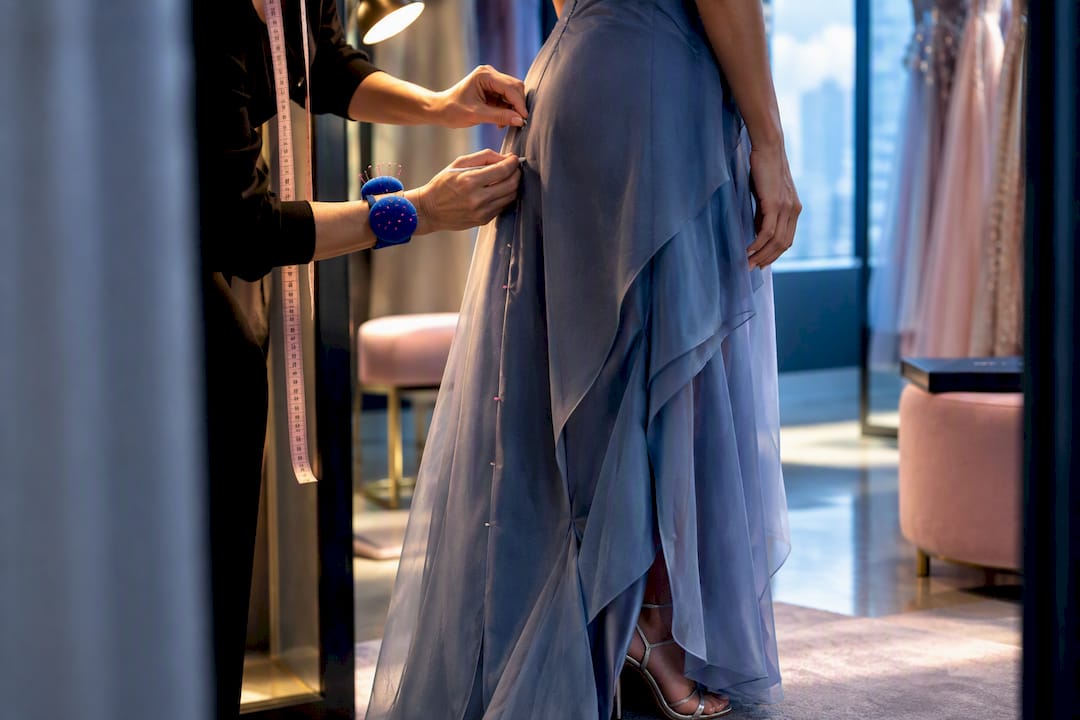
Yes, plan on a few small tweaks when you buy an evening dress online, but you can shrink that list to almost nothing. Measure yourself accurately, compare those numbers to the garment dimensions (not just the size label), and lean toward alteration-friendly silhouettes. Order early, and some retailers’ measurement guides and product pages can help make that planning simpler from the start.
TL;DR:
- Choosing forgiving silhouettes like wrap dresses or A-lines can significantly reduce alteration costs and complexity.
- Verifying garment measurements and internal construction details before purchase predicts how easily a gown can be tailored.
- Most alterations, such as hemming or strap adjustments, cost between $15 and $80, but structured modifications may reach $150 or more.
- Ordering at least several weeks in advance ensures enough time for shipping, fittings, and minor adjustments without rush fees.
- Experienced tailors with a portfolio of formal wear are crucial for complex needs like boned bodices or beaded embellishments.
Table of Contents
- Common Evening Dress Alterations and How Hard They Really Are
- How to Buy So Alterations Are Minimal: Measurement and Ordering Checklist
- Timeline and Cost Estimates for Common Alterations
- A retailer’s perspective on making fit easy
- How to Choose the Right Tailor or Alteration Service
- Questions to Ask Your Tailor Before Starting the Alteration
- Red Flags That Signal a Poor Alteration Service
- What to Expect From Drop-Off to Pickup
- Coordinating Trial Fittings and Final Adjustments
- What Actually Matters When You’re Shopping, Not Searching for a Tailor
- Shop Dress Me Up NY: Evening Dresses Built for an Easier Fit
- Trusted Measurement Guides and Styling Resources
- Sources
- FAQ
Common Evening Dress Alterations and How Hard They Really Are
Every gown needs something. The question is whether that something takes your tailor ten minutes or three hours.
A basic hem is the easiest fix on the list, especially on a simple A-line or straight skirt with a generous seam allowance. Taking a bodice in or out ranks next and is simple on unlined, unboned styles but gets complicated fast once boning, structured lining, or beading enters the picture. Straps are a quick adjustment on most gowns. A bustle for a full skirt (bunching or securing the train so it doesn’t drag) takes more skill, and lining fixes fall somewhere in the middle depending on how the lining is attached to the shell.
Moving a waist seam or adjusting built-in support (cups, boning channels, corset panels) is the most demanding category. It’s what separates a $30 fix from a $150 one.
- Hem adjustment: low difficulty on A-lines and slips; harder on heavily beaded or layered hems
- Take in/out: easy on unlined fabric; hard on boned or fully lined bodices
- Strap resizing: usually simple, quick turnaround
- Bustle for a train: moderate to high, needs an experienced hand
- Lining or waist-seam changes: high difficulty, especially with structured support built in
Before you buy, the product page itself tells you a lot. Visible seam lines, a fully lined bodice, a generous separate hem allowance, or detachable straps and overlays all signal a dress built for easy alteration. Heavy sequin work, fused boning, and bonded (rather than sewn) linings are the opposite signal. Checking fabric, lining, and internal support before you click “buy” is one of the clearest predictors of how alterable a gown will actually be, according to Falors’ guide to shopping designer eveningwear online.
Pro Tip: Zoom in on the product photos around the waist and bust seams. If you can see visible stitching lines and a lining layer, that gown almost always alters more easily than one that looks fused or bonded.
How to Buy So Alterations Are Minimal: Measurement and Ordering Checklist
Fit problems start long before the dress ships. They start with the number you picked at checkout.
A significant proportion of eveningwear returns are due to fit issues unrelated to simple size mismatch. Armhole depth, waist placement, and dart positioning are the usual culprits, according to MioLook’s stylist guidance on fitting evening dresses online. That statistic alone explains why relying on “size 6” or “size medium” gets so many shoppers into trouble. Sizing varies wildly between brands, but garment dimensions don’t lie.
Here’s the checklist that actually works:
- Measure at home first. Take your bust, waist, and hip measurements with a soft tape measured around the fullest point, then measure your height wearing the heels you plan to wear that night.
- Compare to garment dimensions, not the size label. Tellar’s sizing guide for evening dresses recommends matching your actual measurements to the brand’s specific garment chart, since a size 8 at one label can fit like a 4 at another.
- Pick a forgiving silhouette when you’re between sizes. Wrap dresses, bias-cut slips, and A-lines tolerate measurement variance far better than structured corsets or fitted mermaid cuts.
- Favor stretch fabric if you’re on the fence. A little give in the fabric absorbs small measurement gaps that a rigid weave can’t.
- Order with a buffer. If you’re between two sizes on a structured style, order the larger size, since taking in a bodice is almost always easier than letting one out.
If a listing doesn’t show garment measurements clearly, or you’re still unsure after comparing, contact the retailer directly with your exact numbers before you order. Our guide to measuring for evening gowns and other custom-fit questions walks through exactly what to send.
Timeline and Cost Estimates for Common Alterations
Most standard alteration work takes one to three weeks. Rush jobs can be turned around in three to seven days, but that usually comes with a fee, and not every tailor offers it during busy prom or wedding season. Boutiques generally recommend ordering weeks ahead specifically to dodge those rush charges and avoid last-minute panic, a point echoed in Lulus’ guide to shopping for prom dresses online.
Costs vary by region and fabric, but here’s a rough range to budget against:
- Hem: $20 to $80
- Take in or let out: $30 to $150
- Strap adjustment: $15 to $50
- Bustle: $15 to $60
These are approximate. Heavier beading, delicate silk, or multiple layers of lining push every number toward the high end. Once your dress arrives, book your alteration appointment right away and bring clear details, garment fabric, lining type, and what you need done, so the tailor can quote accurately before touching a needle.
A retailer’s perspective on making fit easy
Fit problems are almost always solvable before checkout, not after. That’s the whole idea behind our measurement guides: give shoppers the same garment-level detail a stylist would point out in person, so the gown that arrives needs a quick press instead of a full rebuild.
Use the product measurements and model info on each listing the way you’d use a fitting room mirror. Cross-check them against your own numbers, read the fabric and lining notes, and skim our blog post on evening gown alterations for a step-by-step look at what typically needs adjusting. Small habits here save real money later.
How to Choose the Right Tailor or Alteration Service
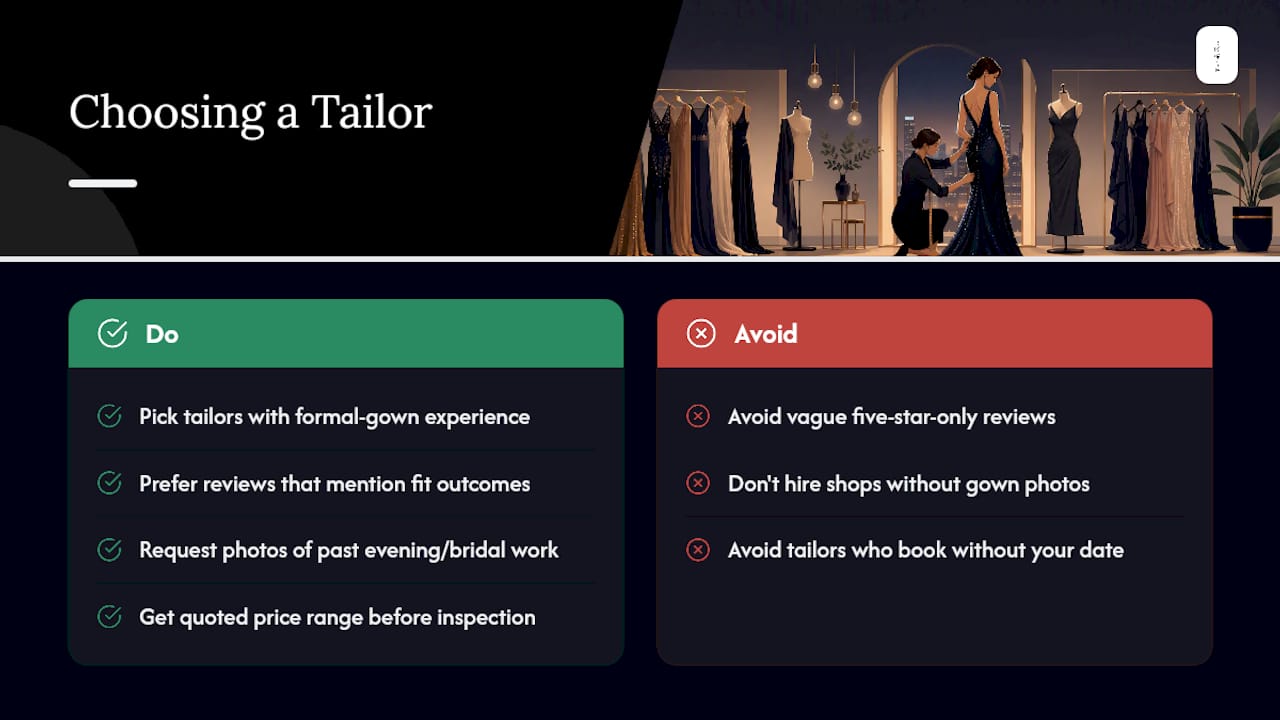
Not every tailor has worked on structured eveningwear, and that gap shows up fast once boning or heavy beading is involved. Look for a shop that can point to real experience with formal gowns specifically, not just suit hems and pant cuffs.
Start with reviews that mention fit notes, not just friendly service. A review that says “took in my bridesmaid dress and it fit perfectly by the second try” tells you more than a five-star rating with no detail. Ask to see photos of past evening or bridal work if the shop has a portfolio; most experienced tailors keep one because they’re proud of it.
Pricing transparency matters too. A shop willing to quote a range before seeing the dress, then confirm the final price after inspecting it, is more trustworthy than one that gives a vague answer until you show up. Ask directly whether they’ve worked with your dress’s fabric type, silk chiffon, sequined mesh, structured satin, since each behaves differently under a needle.
Finally, gauge how they handle scheduling. A tailor who asks about your event date upfront and works backward from it is planning your fitting properly. One who books you in without asking is a sign to keep looking.
Questions to Ask Your Tailor Before Starting the Alteration
A short conversation before any pins go in saves you from surprises at pickup. Bring these questions to your first appointment:
- How many fittings will this alteration need? Complex work like bustling or waist-seam changes often needs two or three visits, not one.
- Will this change the way the fabric or embellishment looks? Beading, lace, or sequins can shift or pucker if not handled carefully.
- What’s the total cost, and does that include a final pressing? Get the full number, not just the “starting at” figure.
- Can you match the thread and trim exactly? This matters most on delicate or colored fabrics.
- What happens if the dress needs more work than expected once you open the lining? Ask how they’ll communicate that before doing extra work you didn’t approve.
Getting clear answers here isn’t about distrust. It’s about making sure everyone’s expectations match before the first cut is made.
Red Flags That Signal a Poor Alteration Service
Some warning signs show up before you even hand over the dress. A shop that won’t give you any price estimate without a hard sell, or that rushes you through the consultation, usually isn’t taking the details of your gown seriously.
Watch for a tailor who won’t let you stay for at least part of the pinning process on a formal gown. Fit is personal, and a good tailor wants your input while marking the alterations, not just your measurements from across the room.
Be cautious of vague timelines. “It’ll be done sometime before your event” is not a real answer. A trustworthy shop gives you a specific pickup date in writing.
Watch out too for a shop that dismisses your dress’s construction details, boning, structured lining, or delicate embellishment, as “no big deal” without asking a single question about the fabric. That kind of overconfidence often leads to damage. And if a shop has zero photos or references of past evening or formal wear, that’s a gap worth noticing before you commit your gown to their hands.
What to Expect From Drop-Off to Pickup
Walking in informed makes the whole process smoother. Most alteration appointments follow a similar arc.
At drop-off, you’ll try the dress on so the tailor can pin exactly where changes are needed, mark those points, and confirm the price and timeline in writing. From there, the dress goes into their queue, standard work generally takes one to three weeks as noted earlier. A mid-process fitting often happens for anything beyond a simple hem, giving the tailor a chance to check progress on your actual body rather than a dress form.
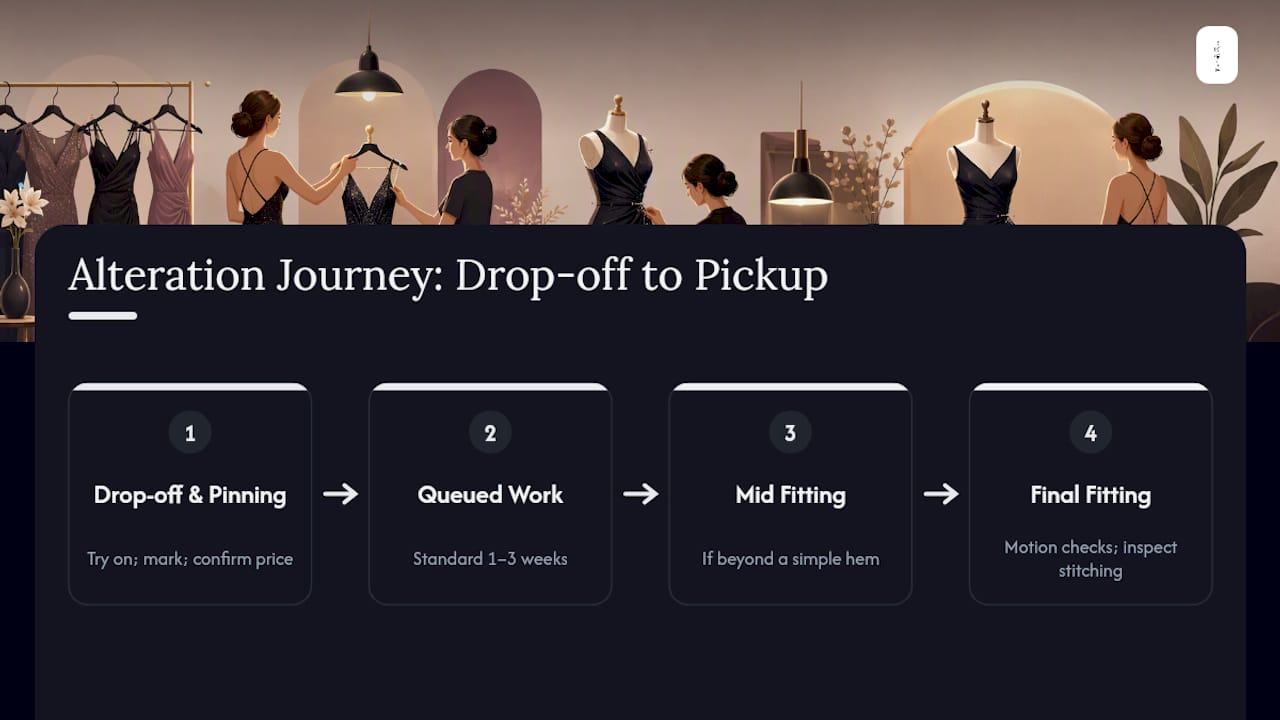
The final fitting is where you try the finished piece on, walk around, sit down, and raise your arms to test range of motion before you approve it. Only after that check should the dress be considered done. Pick it up on a hanger, inspect the stitching in good light, and confirm nothing shifted since the last fitting.
Coordinating Trial Fittings and Final Adjustments
Book your first fitting appointment as soon as the dress arrives, not the week before your event. That buffer gives you room for a second fitting if the tailor finds something during the first pinning that needs more time.
Wear the same undergarments and shoes you’ll actually wear to the event when you go in for fittings. Height and posture change with heels, and a hem pinned in flats can end up crooked once you’re standing at full height. If your event includes dancing or a lot of movement, mention that upfront so the tailor can build in a little ease rather than pinning for a photo-still pose.
Try to schedule your final fitting close enough to the event that last-minute weight or posture shifts won’t undo the work, but with enough cushion that a small tweak doesn’t turn into a scramble.
What Actually Matters When You’re Shopping, Not Searching for a Tailor
Most advice about evening dress alterations assumes you’re starting from a local tailor’s shop window. That’s backwards for how most people actually shop today. The real leverage point is the order you place, not the alteration appointment you book afterward.
The conventional wisdom, “just buy your usual size and get it altered”, ignores how much variance exists between brands and how much that variance costs you later. A gown that needs its waist seam moved and its lining rebuilt isn’t a $30 tailoring job. It’s closer to a $150 one, and it might not turn around in time regardless of budget.
Prioritize the garment dimensions over the size label, choose a forgiving silhouette when you’re unsure, and treat the product page like a fitting room mirror. Do that, and the alteration you eventually book becomes a quick refinement instead of a rebuild.
Shop Dress Me Up NY: Evening Dresses Built for an Easier Fit
Dress Me Up NY gives you a straightforward alternative to gambling on a generic size label: browse Evening Dresses and Formal Gowns with real garment measurements listed on the product page, so you can compare your own numbers before you ever click “buy.”
Filter by silhouette if you want to minimize alteration work from the start. A-line and wrap styles in our Evening Dresses collection tend to forgive small measurement gaps better than heavily structured gowns, while our Formal Gowns category is worth a look if you want a more tailored line and don’t mind budgeting a little extra time for fitting. Pair either page with our blog’s measuring guides while you shop, and you’ll walk into checkout knowing exactly what you’re getting.
Ready to browse? Visit Evening Dresses now and order with at least a few weeks of buffer before your event, enough room for delivery, a fitting, and any small adjustment your tailor recommends.
Trusted Measurement Guides and Styling Resources
A few outside resources are worth bookmarking while you shop. Tellar’s evening dress sizing guide maps your body measurements against dozens of brand size charts, cutting down cross-brand guesswork. MioLook’s stylist fitting guidance breaks down which construction details to check in photos before you buy. And our own evening gown alterations guide and plus-size measurement checklist round out the measuring side with brand-specific tips.
Sources
- How Do I Find My Size in Evening Dresses? - Tellar
- Trying on evening dresses online: stylist tips — MioLook
- Falors
FAQ
Do I really need alterations if I buy an evening dress online?
Most shoppers need at least a minor adjustment, usually a hem or strap tweak, even with accurate measurements. Checking garment dimensions against your own numbers before buying, as recommended by Tellar’s sizing guide, keeps that work small.
Which dress styles need the least alteration?
Wrap dresses, bias-cut slips, and A-line silhouettes tolerate measurement variance better than structured corsets or mermaid cuts, according to MioLook’s stylist guidance. These styles are a smart first choice if you’re unsure about sizing.
How much does a typical evening dress alteration cost?
A basic hem generally runs $20 to $80, while taking a bodice in or out can run $30 to $150 depending on lining and structure. Straps typically cost $15 to $50, and a bustle for a train falls in the $15 to $60 range, though all figures shift with fabric and region.
How early should I order to leave time for alterations?
Order several weeks ahead of your event to leave room for shipping, a fitting, and any adjustment your tailor recommends. Boutique guidance consistently points to ordering early as the best way to avoid rush fees and fit stress close to the date.
Do some retailers offer measurement help before purchase?
Yes, product pages list garment dimensions and Dress Me Up NY’s blog includes measurement guides, including a dedicated post on evening gown alterations to help you plan fit before you order.
Recommended
- Last Minute Dress Solutions: Your Perfect Outfit Awaits
- How to Measure for Dresses for a Perfect Formal Fit
- Where to Find the Right Formal Dress Tailor Near Me