
Lasting Fashion Trends in Formalwear That Stay in Style
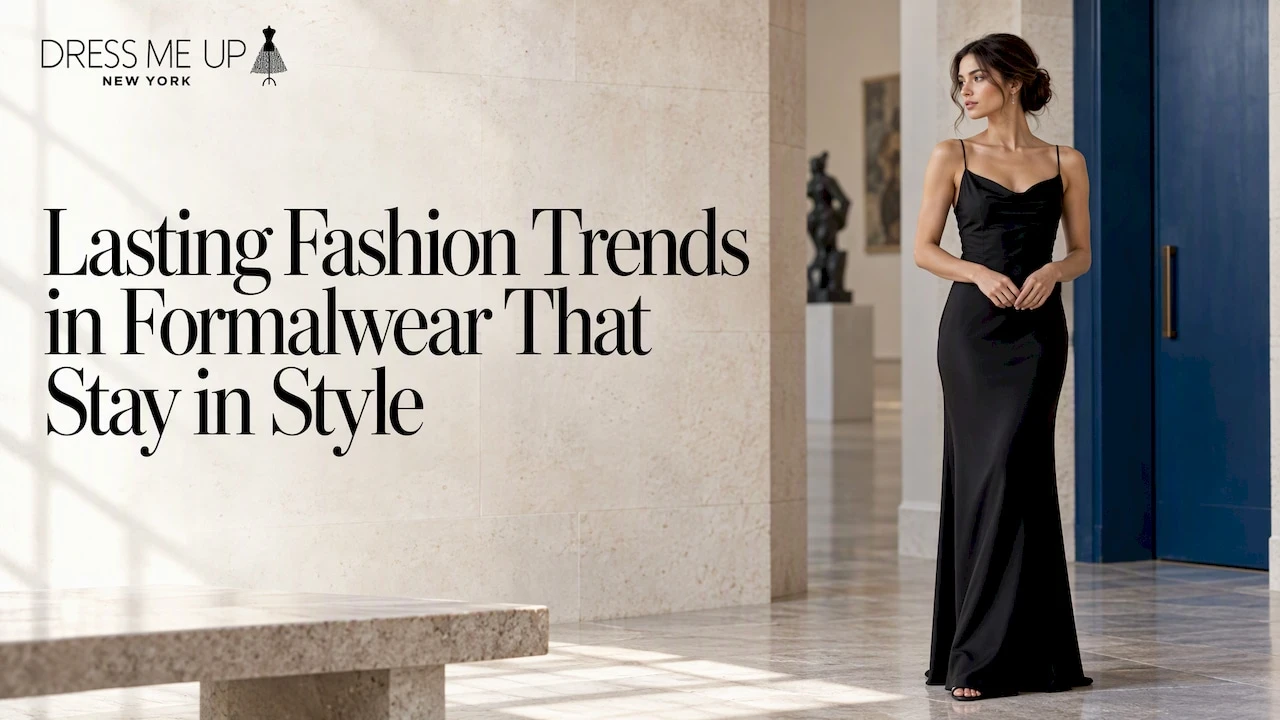
Lasting Fashion Trends in Formalwear That Stay in Style

The formalwear trends that last are the ones built on shape, fabric and fit, not on a single season’s color or cutout. Floor-length lines, clean tailoring, rich fabrics and a few well-chosen vintage nods keep coming back, because they flatter and they photograph well. Below, we explain why trends return, which ones have earned staying power, and how to choose a dress you’ll still love in the photos years from now.
TL;DR
- Fashion tends to cycle back about every 20 years, so the smartest “new” formal look is often a refined version of something that peaked two decades ago.
- Silhouette, fabric quality and fit outlast colors, prints and one-season details.
- Right now, drop waists, pleats, understated glamour and archival-inspired gowns are the shapes with real staying power.
- Pick one trendy detail and keep everything else classic. That’s the easiest way to look current without dating the photos.
- Always check the dress code first. A timeless dress in the wrong formality level still misses.
Table of Contents
- Why formal trends come back (and why that helps you)
- Trends that have earned staying power
- Trends that are fun but fade fast
- Fabric and fit matter more than the trend
- What trends say about us
- How to choose a formal dress that lasts
- Our perspective
- Ready to find your dress?
- FAQ
- Sources
Why formal trends come back (and why that helps you)
If you’ve ever spotted your mom’s prom photo and thought “wait, I’d wear that,” you’ve met the 20-year rule. Scientific American reports that trends tend to reappear on roughly a 20-year cycle, and that researchers have modeled this using a database of more than 35,000 images of women’s clothing, tracking hemlines, necklines and waistlines over about 150 years.
The reason isn’t random. The same piece explains the idea of optimal distinctiveness: we want to belong to a group, but we also want to stand out. A style that faded two decades ago feels familiar enough to be safe and unfamiliar enough to feel fresh.
For anyone buying a formal dress, that’s good news. You don’t have to chase every micro-trend. If you understand which design features cycle, and which ones simply never leave, you can shop with confidence.

The 20-year rule in formalwear
Apply the cycle to a formal closet and a few things stand out:
- Waistlines move. Natural, empire and drop waists take turns. The drop waist, a signature of the 1920s, is making a comeback in wedding guest fashion alongside pleated skirts.
- Necklines shift. Halters, strapless lines and one-shoulder cuts rotate in and out, but each one returns in a cleaner, more modern cut.
- Hemlines swing. For truly formal events, though, length is the stable part. Vogue’s formal attire guide says women should opt for dresses that fall well below the knee, and sometimes floor or ankle length.
The takeaway: waistlines and necklines are where trends play. Length and structure are where formality lives.
Why “vintage” is a useful yardstick
Vogue defines vintage as clothing at least twenty years old but under a hundred, which today covers roughly the 1920s through the early 2000s. That’s a handy lens. If a formal silhouette sits in that window and keeps getting reinterpreted, it has already survived at least one fashion cycle.
Trends that have earned staying power
Not every trend repeats gracefully. These are the formal ideas that keep proving they can last.
1. Floor-length and column lines
A long, streamlined gown is the backbone of formal dressing. It works at a black-tie wedding, a gala, a quinceañera court or a prom, and it rarely looks dated, because the line is simple. If you want one dress to rewear, start here. You can browse ours in formal gowns and evening dresses.
2. The drop waist and pleats
These two have a real moment right now. The Knot’s 2026 wedding guest roundup points to the drop waist and to pleated skirts, which it describes as offering both timeless texture and practical stretch. Pleats move beautifully on a dance floor, and the drop waist gives a relaxed, old-Hollywood feel without looking costume-y.
3. Understated glamour
NYC-based bridal stylist Jackie Avrumson says wedding guest styles tend to celebrate understated glamour, with attention to quality fabrics, interesting silhouettes and a reverence for timeless elegance, as noted in The Knot’s wedding guest trend guide. That sums up what lasts: the dress does the talking quietly.
4. One-shoulder, asymmetric and wrap necklines
Asymmetry has been a formal staple for years because it adds interest without adding fuss. One shoulder, a single strap or an asymmetric neckline gives a plain fabric a focal point. It also gives you a built-in reason to keep jewelry minimal.
5. Tailored jumpsuits
A wide-leg jumpsuit in a fluid fabric is a strong alternative when gowns feel like too much. Vogue’s formal attire guide notes that a sharply tailored suit is an accepted formal option for people who don’t want a free-flowing frock. A dressy jumpsuit follows the same logic: structure plus ease. If that’s your style, take a look at pieces like the Alyce Paris wide-leg jumpsuit with a textured one-shoulder neckline or the Alexander by Daymor sleeveless V-neck long jumpsuit.
6. Classic monochrome
Solid, single-color dresses are the easiest to wear again and again. In Vogue’s gala guide, one guest describes keeping to monochromatic styles that are classic rather than trend-forward, with an element of fun or glamour added in. That formula is worth borrowing.
Trends that are fun but fade fast
Trends aren’t bad. They just come with a shelf life. Here’s how to tell what you’re buying.
| Element | Lasting or short-lived? | How to wear it |
|---|---|---|
| Floor-length silhouette | Lasting | Make it the base of the look |
| Solid jewel tones, black, navy, champagne | Lasting | Add one fun accessory |
| Pleats, drop waist | Cycling back, with real staying power | Choose a soft fabric with good drape |
| Bold prints and neon shades | Seasonal | Great for one memorable event |
| Heavy cutouts and very high slits | Seasonal | Pick one, not both |
| Novelty textures and oversized embellishments | Seasonal | Keep the cut simple around them |
A good rule: if the detail could be removed and the dress would still look elegant, it’s safe to enjoy it. If the detail is the entire dress, you’re buying a moment.
Fabric and fit matter more than the trend
Trends tell you what’s popular. Fabric and fit tell you whether you’ll still like the dress in photos five years from now.
A few things we’d look for:
- Weight and drape. Satin, crepe, stretch georgette and good chiffon hang cleanly. Thin, shiny fabrics that cling can look dated fast.
- Lining and structure. Even royal wardrobes lean on this. Vogue reports that Queen Elizabeth II’s outfits were often adapted and rewarn, sometimes for decades, and it describes details such as extra lining behind heavily beaded dresses for comfort. Good construction is what makes a garment last.
- Fit in the places that matter. Shoulders, bust and the waist seam. A hem can be fixed easily. A bodice that fights you all night can’t.
If you want to go deeper on why material quality shows up in how clothes look and last, this explainer on why high-quality fabrics matter is a good companion read before you shop.
What trends say about us
Vogue’s guide quotes luxury fashion consultant Amanda Jane Valentine, who says formal attire is more than a dress code. It’s a way of showing respect for significant milestones, and what we choose to wear communicates social awareness before we say a word. You can read her thoughts in The Vogue Guide to Formal Attire.
There’s also a playful side. Cultural critic Anne Hollander argues in Vogue’s piece on vintage clothes that modern fashion is self-conscious: we admire the formality of earlier eras while keeping a critical distance, mocking and praising old styles as we bring them back. In practice, that’s why a 1920s drop waist on a 2026 guest looks charming rather than costume-like. We take the shape and update the fabric, the length or the styling.
How to choose a formal dress that lasts
Here’s a simple process we’d walk a friend through.
- Start with the dress code. Read the invitation closely. If it isn’t clear, The Knot advises checking the couple’s wedding website first, since modern weddings are moving away from one-size-fits-all etiquette. Our guide to navigating dress code nuances can help you decode the wording.
- Choose the silhouette before the color. Pick the shape that makes you feel most like yourself: A-line, column, mermaid, jumpsuit.
- Pick a color you already wear well. Deep tones, soft neutrals and classic black rarely let you down. Our tips on choosing colors and fabrics for the season go further.
- Add one trend. A pleated skirt, a drop waist, a structured shoulder. One is plenty.
- Check the fabric. Look at the lining, the weight and the seams in the product photos and descriptions.
- Plan for the second wear. Ask where else you could wear it: a rehearsal dinner, a holiday party, a graduation celebration.
Occasion by occasion
Prom. Prom is where trends are loudest, so it’s the place to have fun. If you’d like it to age well, anchor the look with a classic color or silhouette and let one detail, like a corset bodice or a sparkle accent, carry the trend.

Quinceañera. This is a once-in-a-lifetime milestone that will be on the walls for decades. Many families lean toward timeless ball gown shapes, then personalize with color and embellishment. Browse our quinceañera dresses to see that balance in action.
Wedding guests and bridesmaids. Understated glamour wins. Our wedding guest and bridesmaid collection is organized to make this easier, and our wedding guest dress etiquette guide covers the unwritten rules.
Cocktail and party. Semi-formal events are the place for shorter hemlines. Check out cocktail dresses, designer mini dresses and jumpsuits, and read our notes on semi-formal and cocktail guidelines.
Our perspective
We spend our days helping women and teens find dresses for proms, weddings, quinceañeras and galas, and one pattern shows up again and again: the dress people regret is rarely the classic one. It’s the one bought because a single detail was everywhere that month.
So here’s how we think about it. A dress should be built on the things that don’t change: a flattering line, a fabric that moves well, and a length that suits the event. Then let the trend be the guest star. A pleated skirt, a drop waist or a bold shoulder can make a timeless dress feel like it belongs to this year.
That’s also why we organize our catalog by event, designer and style. When you shop by occasion first, the dress code does half the filtering for you, and you can focus on what feels like you. Our team is made up of experienced fashion professionals, and if you’re torn between two options, we’re glad to help you think it through. You’ll find collections curated from New York’s fashion district and global designers, and you can see what’s new in our guide to designer dress collections for 2026 special occasions.
Trends are a great way to play. Timelessness is how you feel confident when the camera comes out.
— Dressmeup
Ready to find your dress?
If you’ve read this far, you probably have an event on the calendar. Start with the category that matches it: formal gowns for black-tie and gala nights, evening dresses for classic elegance, or the wedding collection for guests and bridesmaids. Our catalog is organized by event, designer and style, so you can narrow things down quickly and get back to the fun part: picturing yourself in it.
If you’d like a gift for someone who loves a special occasion look, we also offer gift certificates.
FAQ
What is the 20-year rule in fashion?
It’s the observed pattern that styles, especially hemlines, necklines and waistlines, tend to return to popularity about 20 years after their last peak. Scientific American describes researchers modeling this with a database of more than 35,000 images of women’s clothing. It’s a pattern, not a law, so use it as a guide rather than a guarantee.
What formalwear never goes out of style?
Floor-length gowns with clean lines, tailored pieces and solid, classic colors have stayed relevant across many cycles. Vogue’s guidance on formal attire emphasizes dresses well below the knee, and sometimes floor or ankle length, for the most formal events. Quality fabric and good fit keep these looks fresh.
What’s the most popular formal dress trend right now?
For wedding guest and special occasion dressing, The Knot highlights the drop waist silhouette and pleated skirts, mixed with understated glamour. At prom, you’ll also see plenty of personal expression, so the answer depends on the event. Choose one trend you love and keep the rest classic.
How do I keep a trendy dress from looking dated?
Let one detail carry the trend and keep the base simple: a classic color, a clean silhouette and good fabric. Style it with minimal accessories so the dress can be restyled for later events. Avoid stacking several current trends on one dress.
Should I follow the dress code or the trends?
Follow the dress code first, always. If the invitation isn’t clear, check the couple’s wedding website, as The Knot recommends. Once the formality level is right, trends are the fun layer on top.
Sources
- The math that explains why Y2K is back in fashion, Scientific American
- Wedding guest dress trends, The Knot
- The Vogue Guide to Formal Attire, Vogue
- What Is Considered Vintage?, Vogue
- What to Wear to a Gala to Look Chic and Timeless, Vogue
- The Queen’s Style Is a Royal Lesson in Modern Dressing, Vogue
- From the Archives: A Boom in Vintage Clothes, Vogue
Recommended
- One Focal Piece Makes Timeless Formalwear Accessories Work
- 2 Piece Formal Wear: Style, Versatility, and Impact
- Key Strategies for Maintaining Formal Wear Quality