
Size 8 Dress Measurements: Bust, Waist and Hips Guide
Size 8 Dress Measurements: Bust, Waist and Hips Guide

A U.S. size 8 dress is commonly listed at a 35–36 inch bust, a 29–30 inch waist and 38–39 inch hips, according to a widely published U.S. size chart. That is a starting point, not a promise. Every brand cuts its own sizes, so the number on the tag only tells you where to begin. Your tape measure tells you the rest.
Below, we walk through the numbers for sizes 6, 8 and 12, show you how to measure at home, and explain how to choose a formal dress when your measurements fall between two sizes. Prom, wedding guest and gala dresses are less forgiving than a casual sundress, so a little prep goes a long way.
TL;DR
- A typical U.S. size 8 is a 35–36 inch bust, 29–30 inch waist and 38–39 inch hips. Size 6 is 34–35, 27–28 and 36–37. These are general ranges.
- Brands size for their own customers, so an 8 at one label can fit differently at another. Always compare your numbers with the chart on the product page.
- Measure bust, waist and hips with a soft tape, breathing normally, then size for your largest measurement and alter down.
- Fabric, cut and lining change how a size feels. Stretch fabrics forgive. Structured bodices and corsets do not.
- Our step-by-step measuring guide walks you through each measurement.
Table of Contents
- Size 8 dress measurements at a glance
- Why size 8 is not the same everywhere
- How to measure for a size 8 dress
- Which measurement should decide your size?
- Between sizes? Here is how to decide
- What about size 6 and size 12?
- Reading a size chart on a formal dress
- Our perspective
- Ready to find your size 8 dress?
- FAQ
- Sources
Size 8 dress measurements at a glance
Start with the numbers most U.S. shoppers are looking for. The table below combines two published references. The inch ranges come from SizeChart.com’s U.S. women’s chart, which labels them as general ranges. The centimeter figures come from a dress size calculator based on a standard retailer table, and the inch equivalents of those are our own conversions, rounded.
| U.S. size | Bust (in) | Waist (in) | Hips (in) | Bust / waist / hips (cm) |
|---|---|---|---|---|
| 6 | 34–35 | 27–28 | 36–37 | 88 / 70 / 93.5 |
| 8 | 35–36 | 29–30 | 38–39 | 93 / 75 / 98.5 |
| 12 | not listed in this chart | not listed in this chart | not listed in this chart | 103 / 85 / 108.5 |
For size 12, the centimeter figures work out to roughly a 40.5 inch bust, 33.5 inch waist and 42.5 inch hips. Treat that as an approximation and confirm it against the brand’s own chart.
Notice that the two sources do not match exactly. The calculator’s size 8 bust is 93 cm, about 36.6 inches, while the inch chart tops out at 36. That gap is normal. It is the first sign of why you should never shop by the label alone.
Size 8 across U.S., UK and EU labels
If you are shopping from an international designer, the label may not say 8 at all. One international conversion chart maps U.S. 6 to UK 10 and EU 38, U.S. 8 to UK 12 and EU 40, and U.S. 12 to UK 16 and EU 44. It presents these as approximate and notes that brands vary.
| U.S. | UK | EU |
|---|---|---|
| 6 | 10 | 38 |
| 8 | 12 | 40 |
| 12 | 16 | 44 |
So if a designer gown lists a UK 12 or EU 40, you are looking at roughly the same size as a U.S. 8. Roughly is the key word, and we will come back to it.
Why size 8 is not the same everywhere
It can feel frustrating to be an 8 in one store and a 10 in another. You are not imagining it, and it is not your body. It is how sizing works.
HuffPost reported in February 2026 that brands base their sizing on the customers they want to serve, and that typical body shapes differ by age group, market and geography. Its example: a U.S. size 6 at one retailer need not match a size 6 from the same retailer in Kazakhstan.
There is also history behind it. Wikipedia’s overview of U.S. standard clothing sizes explains that vanity sizing and other cultural pressures have pushed North American sizes far from the original standard, so a label at one brand may not match another.
The practical takeaway is simple and a little freeing: the number is a label, not a verdict. Your measurements are the real data.
Fabric and construction matter too
Two dresses with identical measurements can fit very differently. The Straits Times notes that measurements are a guide rather than a guarantee, because fabric type, cut and construction all affect fit. It recommends checking a product’s details, including fabric composition and intended fit, before you buy. It also points out that bodies can change from week to week, for example with the menstrual cycle.
For formalwear, that means:
- Stretch satin, jersey and crepe have give, so a slightly snug fit often relaxes.
- Structured bodices, boning and corset backs hold their shape, so bust and waist numbers matter more.
- Lined, beaded or heavily embellished gowns have little to no stretch, so choose by your largest measurement.
How to measure for a size 8 dress
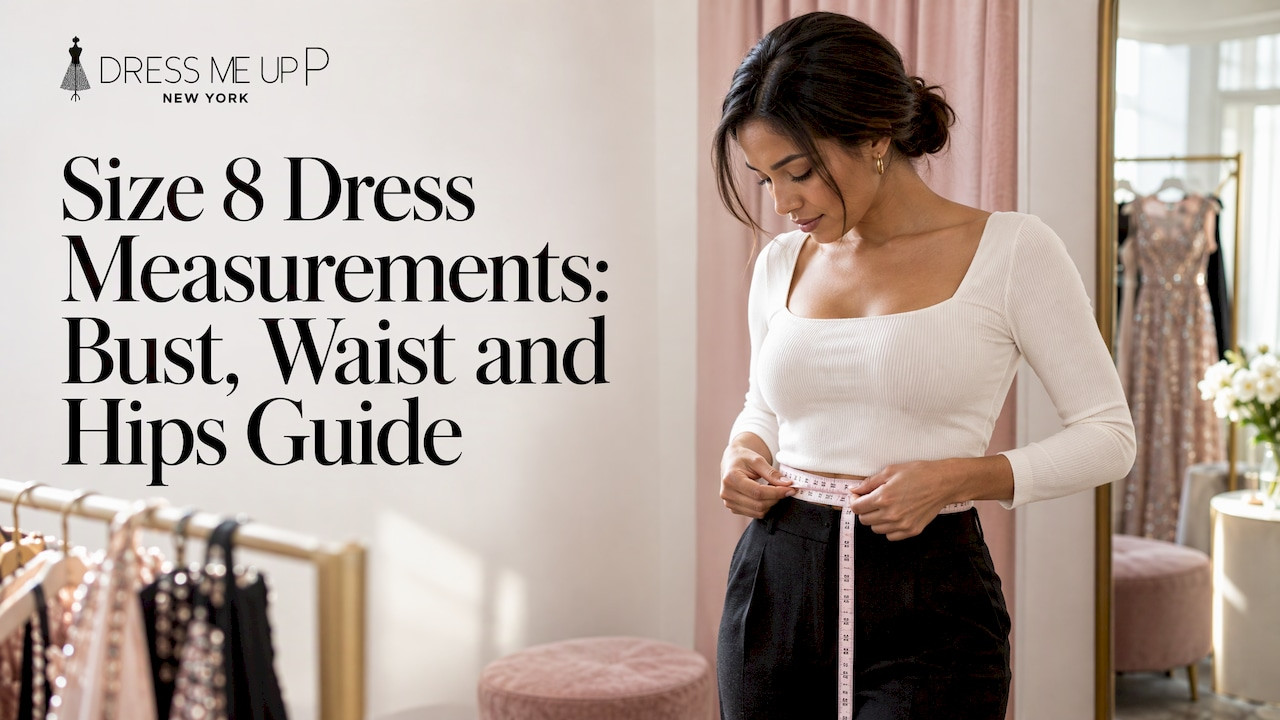
Grab a soft tape measure (the flexible kind used for sewing, not a metal one) and a mirror. Wear thin, close-fitting clothes or just your undergarments. For a bodice with a built-in bra, wear the bra you plan to wear on the day.
Here is the method, drawn from Tellar’s dress sizing guide and the European size-labelling standard EN 13402:
- Bust. Wrap the tape around the fullest part of your chest, keeping it parallel to the floor, and breathe normally. EN 13402 defines bust girth as the maximum horizontal girth during normal breathing, measured under the armpits and across the bust prominence.
- Waist. Measure at your natural waist, usually the narrowest part of your torso, about an inch above your navel. EN 13402 places it between the top of the hip bones and the lower ribs, with your abdomen relaxed.
- Hips. Measure around the fullest part of your hips and bottom, typically 8–10 inches below your natural waist.
- Write all three down. Measure twice. If the two readings differ, take the larger one.
Keep the tape snug but not tight. You should be able to slide one finger under it. If you want photos and extra measurements like torso length and shoulder width, our guide covers additional body measurements and the common measurement mistakes to avoid.
A quick worked example
Say you measure a 36 inch bust, a 29 inch waist and 40 inch hips. Against the size 8 range (35–36, 29–30, 38–39), your bust and waist fit an 8, but your hips are an inch past it. For a fitted sheath or mermaid gown, you would size for the hips first. For a flowy A-line or an empire-waist gown that skims the hip, the bust matters most, so an 8 may work well.

That leads to the rule that saves the most returns.
Which measurement should decide your size?
Tellar’s advice is to size for your largest measurement and alter from there, because letting out a seam is easier than adding fabric. It also suggests matching the measurement to the silhouette:
| Dress style | Size for |
|---|---|
| Fitted or structured dresses | Hips first |
| Wrap dresses | Bust and hips |
| Empire-line dresses | Bust |
In formalwear, apply the same idea. A strapless gown with boning is decided by your bust and waist. A mermaid or column gown is decided by your hips. A ball gown skirt has room, so the bodice sets the size. A tailor can usually take in a waist or bodice, which is why many people with a pear or hourglass shape buy for the largest number and have it tailored.
Between sizes? Here is how to decide
Most of us are not a perfect textbook size 8 on all three measurements. Here is a simple way to handle it:
- Bust is a size 8, hips a size 10: choose the 10 for fitted skirts, the 8 for flared skirts.
- Waist is between sizes: check whether the dress has a waist seam, a corset back or an elastic panel. Those details add adjustability.
- Measurements sit right on the line: go up. Taking a dress in is easier than adding fabric.
- You are somewhere between a 6 and an 8: check the stretch of the fabric. A stretch crepe may work in the smaller size, while a rigid satin needs the bigger one.
- Still unsure: ask our team. We are experienced in fashion and happy to help you compare your measurements with a style.
If you are shopping for a younger shopper, for example prom or a Quinceañera, remember that fit can change fast during growth spurts. Measure close to your order date, not months ahead.
What about size 6 and size 12?
Many readers who search for size 8 are also checking the sizes on either side, so here is how they compare.
Size 6. Around a 34–35 inch bust, 27–28 inch waist and 36–37 inch hips on the U.S. chart. That is roughly 2 inches smaller than a size 8 in the bust and about 2 inches in the hips. In the international conversion, it matches a UK 10 and EU 38.
Size 12. About 103 cm bust, 85 cm waist and 108.5 cm hips in the calculator’s table, which corresponds to a UK 16 and EU 44. The step from 8 to 12 is about 10 cm (roughly 4 inches) in each measurement.
For reference, the European standard uses mostly 4 cm steps between women’s sizes, widening to 5 cm for hips and 6 cm for bust and waist in larger sizes. In U.S. sizing, the jump between even sizes is smaller than between 8 and 12 might suggest, since each size sits roughly 1 to 2 inches apart in a typical chart.

Reading a size chart on a formal dress
Formalwear often has its own chart, and it may differ from your everyday clothes. Before adding a dress to your cart:
- Find the size chart on the product page and compare all three measurements, not just the bust.
- Check the fabric and lining. Look for words like stretch, boned, corset or zip.
- Note the silhouette (mermaid, A-line, sheath, ball gown) and use the table above to pick the measurement that rules.
- Look at the length. Floor-length gowns depend on your height and heel height, so factor in the shoes you plan to wear.
- Leave time before your event for alterations. Hemming and taking in a bodice are common, and a tailor needs a few weeks at busy seasons like prom and wedding season.
Our guide to taking accurate dress measurements goes deeper on technique, and the sections on bust and chest and waist and hip measurements are handy to keep open while you measure.
Our perspective
We hear it all the time: “I’m a size 8 everywhere else, so why doesn’t this gown fit?” Formal dresses are cut differently from jeans and tees, and every designer works from their own fit model. That is why we organize our catalog by event, designer and style, so you can narrow down quickly and then check each dress against your own numbers.
Our advice is the same for a prom dress, a wedding guest dress or a Quinceañera gown: measure first, shop second. When your bust, waist and hips land in different sizes, pick the size that fits your largest measurement and plan on a quick tailoring visit. A great fit is often one small alteration away.
Our team has a fashion background and loves helping you work through this, whether you are choosing between an 8 and a 10 or deciding on a silhouette that suits your shape. You do not have to guess. Bring your measurements, tell us about your event, and we will help you find a dress you feel amazing in.
Dressmeup
Ready to find your size 8 dress?
Once you have your numbers, browsing gets much easier. We carry formal gowns, evening dresses, wedding guest and bridesmaid dresses, cocktail and party styles and Quinceañera dresses, all sorted by event, designer and style so you can get to the right silhouette fast.
Keep your measurements handy, check the size chart on each product page, and reach out to our team if you want a second opinion on fit. Watch our site for current promotions and shipping offers.
FAQ
What are the measurements for a size 8 dress?
A commonly published U.S. chart lists size 8 at a 35–36 inch bust, 29–30 inch waist and 38–39 inch hips. A standard retailer-based table puts it at 93 cm bust, 75 cm waist and 98.5 cm hips. Brands vary, so use the chart on the dress you want.
Is a size 8 the same as a medium?
Not always. Some references pair size 8 with a medium, while others place it between a medium and a large. Letter sizes are even less standardized than numbers, so rely on your bust, waist and hip measurements rather than the letter.
What is a size 8 in UK and EU sizes?
A U.S. 8 is roughly a UK 12 and an EU 40 on a representative conversion chart. These are approximate conversions, so check the designer’s own chart when buying an international label.
Should I size up or down for a formal dress?
Size for your largest measurement, because a tailor can take a dress in more easily than they can add fabric. If you are between sizes and the dress has no stretch, size up. If it has a stretch fabric or a corset back, the smaller size may work.
How often should I re-measure before an event?
Measure again close to when you order. Bodies can change from week to week, and younger shoppers may be growing. A fresh set of numbers a few weeks before your event helps you pick the right size.
Sources
- Women’s US Size Chart, SizeChart.com
- Dress Size Calculator: UK, US & EU Reference, KeenCalc
- International Dress Size Chart, Size.ly
- The Real Reason Clothing Brands Don’t Use Universal Sizing, HuffPost
- Inside the confusing world of women’s clothing sizes, The Straits Times
- U.S. standard clothing size, Wikipedia
- Joint European standard for size labelling of clothes, Wikipedia
- How Do I Find My Size in Dresses?, Tellar