
Winter Gala Gown Guide: What to Wear, Fabrics and Warmth
Winter Gala Gown Guide: What to Wear, Fabrics and Warmth

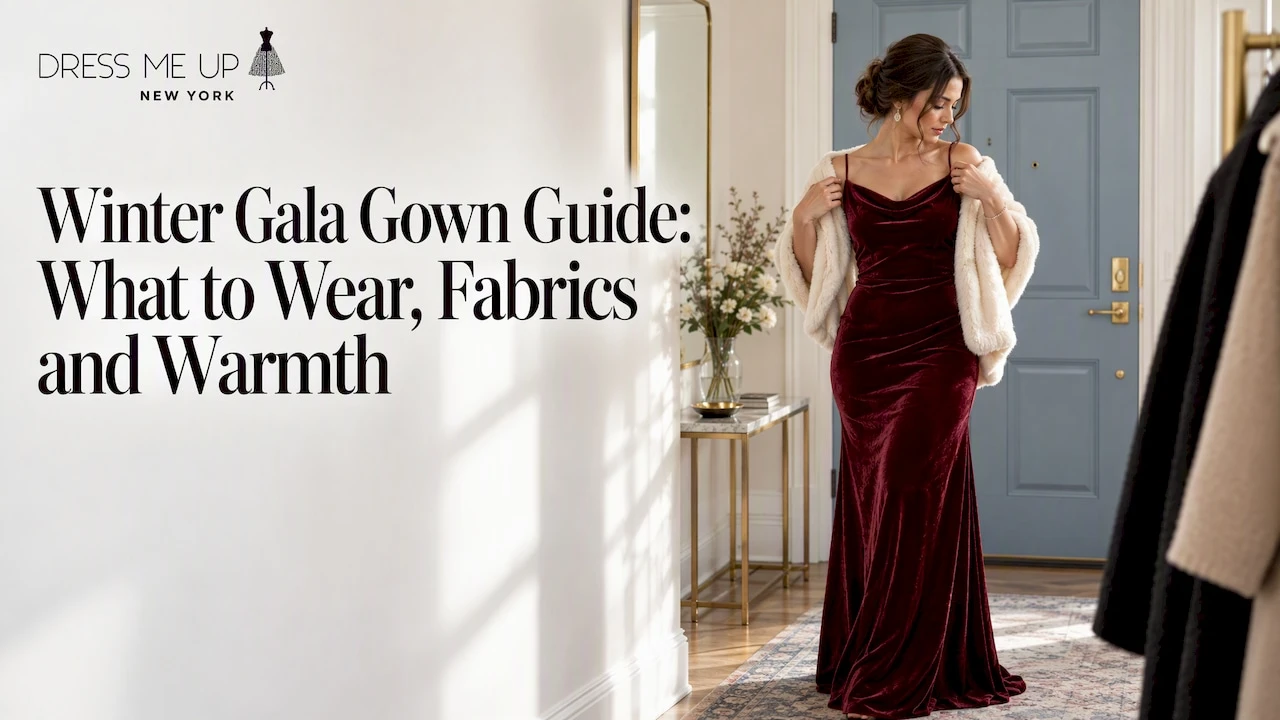
The best winter gala gown is floor-length, made in a fabric with some weight (think velvet, crepe or heavy satin), and cut so you can layer a thermal base and a proper wrap without losing the silhouette. Get those three things right and everything else, from color to shoes, is the fun part. Below, we walk you through how to choose, how to stay warm, how to finish the look, and how the choice shifts if you’re headed to a prom, a Quinceañera or a wedding instead.
TL;DR
- Pick floor-length for a black-tie gala. Midi to floor-length works for a formal dinner.
- Choose fabrics with body in winter: velvet, satin, crepe, or sequins when the event is festive.
- Plan warmth first: a slim thermal layer, opaque tights or leggings you can remove, and a wrap or coat tried on with the gown.
- Do a sit-and-walk test in the exact shoes and undergarments you will wear.
- Let one element lead, either the gown or the accessories, so the look feels intentional.
Table of Contents
- What a winter gala really asks of your gown
- Silhouettes and lengths that work in winter
- Fabrics, colors and sleeves
- How to stay warm without hiding your gown
- Finishing the look: shoes, jewelry and a bag
- Fit and comfort checks before the big night
- Gala, prom, Quinceañera or wedding: how the choice shifts
- Our perspective: dress for the night, not just the photo
- Ready to find your gown?
- A simple winter gala checklist
- FAQ
- Sources
What a winter gala really asks of your gown
A gala sits at the dressy end of the dress-code scale. Invitations usually say black tie, black-tie optional or formal, and each one nudges your choice. Fashion editors put it simply: black-tie dinners call for floor-length dresses, while formal dinners suit midi-to-floor-length. If your invitation is vague, floor-length is the safe answer. Nobody has ever been turned away for being too elegant at a gala.
Winter adds a second set of rules that summer galas don’t have:
- You will travel in the cold, often from a car to a door, sometimes across a parking lot or a sidewalk.
- Venues swing between drafty entrances and warm ballrooms, so you need layers that come off easily.
- Heavier fabrics photograph beautifully in low evening light, so they are worth choosing on purpose.
If you want a second opinion on the dress-code side, our guide to what winter formal means for your dress code breaks down the common wording on invitations.
Silhouettes and lengths that work in winter
Silhouette is where comfort and elegance meet. Here is how the main shapes behave in cold weather.
| Silhouette | Why it works in winter | Keep in mind |
|---|---|---|
| A-line | Balanced shape with room for a thermal layer underneath | Easy to move and dance in |
| Ball gown | Full skirt hides leggings or tights and gives a classic gala moment | Needs space for a coat that won’t crush it |
| Mermaid or fitted | Sleek and dramatic | Little room for layers, so rely on a wrap and warm tights |
| Column or sheath | Clean line, pairs well with long sleeves | Check you can walk and climb stairs comfortably |
| Dress with a slit | Adds ease of movement | Opaque tights or a fitted layer may show, so plan them |
Floor-length gowns do a lot of the work for you: more fabric on your legs means less need for extra layers. Maxi lengths are exactly what InStyle’s winter dressing guide points to as extra coverage in cold weather, alongside velvet, wool flannel and faux leather for insulation.
If you want more on cuts and cloth, we cover it in our post on fabrics and silhouettes that work best for winter formals.
Fabrics, colors and sleeves
Fabrics with body
Velvet is the obvious winter choice, and it’s having a moment. A Vogue trend piece quotes a retail executive saying that in-store arrivals of velvet jackets rose 35% year on year for Fall/Winter 2025. Velvet is warm, it moves beautifully, and it needs very little jewelry.
Other fabrics worth a look:
- Satin and duchess satin: structured, glossy, and formal enough for any ballroom.
- Crepe: drapes cleanly and gives a polished, minimal line.
- Sequins and beading: festive and ideal for a holiday or New Year’s gala. One fashion magazine calls sequins a sartorial staple for New Year’s Eve.
- Tulle over a lined base: romantic and airy, best when you add a warm layer underneath.
A quick tip: lined gowns are warmer and hold their shape better, so look for “fully lined” in the product details.
Colors that feel like winter
Jewel tones such as emerald, sapphire, burgundy and deep plum look rich against winter light. Black is always right, and navy is a quiet alternative. Metallic champagne, silver and gold fit holiday galas. Red is bold and photographs well. If you prefer a softer look, ice blue, dusty rose and ivory tones work too, but check the event: ivory and white can compete with a bride at a wedding.
For more on what looks best on camera, see our notes on colors and embellishments that photograph best.
Sleeves are your secret weapon
Long sleeves, three-quarter sleeves, off-the-shoulder styles with detachable sleeves, and illusion sleeves all give warmth without adding a layer. A long-sleeve gown is the simplest answer to a cold night. If you love a strapless or sleeveless cut, pair it with a wrap, cape or evening jacket instead.

How to stay warm without hiding your gown
This is the part most guides skip, and it’s the part you’ll remember at 10 p.m. when you’re waiting for a ride. A few principles make it easy.
- Start with a slim base. A thin thermal top or fitted roll-neck under a gown with sleeves or a higher neckline, plus thermal or opaque tights. InStyle names thermal tights, turtlenecks and long sleeves as useful bases.
- Keep layers in the same color family. Staying within two or three tones makes the outfit look planned rather than bulky.
- Choose your outer layer for the gown, not the weather alone. A faux-fur stole, a velvet cape, a tailored wool coat or a long wrap each have a role. A short jacket can interrupt the line of a long gown, so a wrap or longer coat tends to look better.
- Try the wrap on with the dress. It should not crush the skirt, hide the silhouette, or snag on delicate beading. Do this at home well before the event.
- Plan the ride home. Bring a pair of thin leggings or soft wool trousers to pull on under a full skirt if the wait is long.
Our detailed walkthrough, master winter formalwear layering, shows how to build these layers step by step. And for a quick answer, our section on staying warm without hiding your dress covers the basics.
Shoes and tights
Closed-toe or strappy heels both work for evening. If you will wear tights, choose a shoe with enough coverage that the toe seam doesn’t show, or pick tights designed for open toes. If your venue involves snow or wet pavement, carry your heels in a bag and wear boots to the door, then change in the coat check. It’s a small step that saves your hem and your ankles.

Finishing the look: shoes, jewelry and a bag
Once the gown is settled, the accessories should follow one simple idea: decide what leads. If the gown is heavily beaded or sequined, keep jewelry quiet. If the gown is clean and minimal, that’s your chance to add a statement. A minimalist holiday approach is to keep the dress understated and let shimmer come from accessories.
Here is how we’d build it:
- Shoes: Pick comfort you can stand in for four hours. A block or stiletto heel in metallic, black or a shade that matches your gown works with almost everything. Nude-to-skin tones lengthen the leg under a floor-length hem.
- Jewelry: Choose either a statement earring or a statement necklace, not both. With a high neckline or heavy embellishment, go for earrings and a slim bracelet. With a strapless or V-neck gown, a necklace adds structure.
- Metals: Silver and crystal suit cool colors like blue, black and emerald. Gold complements warm tones like burgundy, rust and champagne.
- Bag: A small clutch or minaudière is enough: phone, lipstick, card, keys. A metallic or velvet clutch picks up the tone of the evening without competing with the dress.
- Hair and beauty: An updo shows off a neckline or earrings, while loose waves suit a high neck. Match your lip color to the mood, deep berry for jewel tones, classic red for black.
Our section on accessories and shoes that complete a winter formal look has more combinations to borrow.
Fit and comfort checks before the big night
A gown can look perfect on a hanger and still fail in real life. Before the event, run this routine:
- Put on the gown with the exact undergarments and shoes you plan to wear.
- Walk across the room, climb a few stairs, and sit down in a chair. Check that the hem clears the floor without dragging and that nothing pulls or rides up.
- Raise your arms, hug someone, and (if there’s dancing) take a twirl.
- Check the zipper and any hooks. Make sure the fabric is secure at the bust.
- Add your wrap and walk again.
If something is off, you have time to hem, tape or swap it. The more of this you do a week out rather than the night before, the calmer you will be.
For online buyers, sizing is the other half of this. Measure your bust, waist and hips, compare them with the size chart on the product page, and read details like stretch, lining and boning. Our guide to choosing the right size and silhouette online goes through it, and our overview of the smartest way to shop for a winter formal dress online will help you plan timing so there’s room for alterations.
Gala, prom, Quinceañera or wedding: how the choice shifts
The same season, very different expectations. Here’s how we think about each.
Winter gala attendee
Galas reward polish. Choose floor-length, a rich fabric and refined accessories. You will probably stand, mingle and dine, so prioritize a gown that looks good from every angle and lets you sit through a long dinner. For more ideas, see our post on winter gala dinner dresses.
Prom or school winter formal
For school winter formals, think dancing first. You want secure construction, a hem you won’t trip on and a bodice that stays put. Then have fun with color, sparkle and cut-outs. Browse our formal gowns for long silhouettes in sequins, satin and more.
Quinceañera
A Quinceañera is a milestone with ceremony, photographs and dancing, often across several hours and venues. A full skirt looks wonderful in winter because it leaves space for warm layers. Many families like to keep a wrap or shawl nearby for church and outdoor photos. Explore our Quinceañera dresses for ball gowns and more.
Wedding guest or bridesmaid
At a winter wedding, the rule is to avoid white, ivory and anything that competes with the bride. Velvet, deep jewel tones and long sleeves are lovely. Check the dress code on the invitation and the venue: a church ceremony may call for covered shoulders, so a wrap is practical. See our wedding guest and bridesmaid dresses.
Our perspective: dress for the night, not just the photo
We see the same pattern every winter. Someone falls in love with a gown, then realizes the night involves a cold walk, a long dinner and a dance floor. The dresses that people love most are the ones that work for all of that, not just the first five minutes.
Our catalog is organized by event, designer and style, so you can narrow quickly to what suits your night, whether that is a gala, a prom, a Quinceañera or a wedding. Our team of fashion professionals is happy to help you think through length, fabric and fit, because the best gown is the one that lets you forget what you’re wearing and enjoy the evening.
Our advice is simple. Decide on the warmth plan before you fall for the neckline. Try everything together: gown, shoes, wrap. Then pick one hero, either the dress or the accessories, and let it shine.
— Dressmeup
Ready to find your gown?
If you’re ready to start looking, our evening dresses and formal gowns collections are organized by event, designer and style, so you can go from browsing to a short list quickly. Planning a cocktail-style event instead? Our cocktail dresses, designer jumpsuits and mini dresses are worth a look. We also sell gift certificates if you’re shopping for someone else.
A simple winter gala checklist
- Confirm the dress code and venue (indoor, outdoor, valet or a walk).
- Choose a length that fits the code: floor-length for black tie.
- Pick a fabric with weight and a lining.
- Buy or borrow a wrap or coat and test it with the gown.
- Choose tights or thermal layers that match your skin tone or gown color.
- Do the sit-and-walk test in your shoes.
- Pack a small bag: lipstick, phone, card, tissues, a few bobby pins.
- Keep comfortable flats or boots in the car or coat check.
FAQ
What is the best fabric for a winter gala gown?
Velvet is the warmest and most seasonal choice, and it needs little embellishment. Satin, crepe and lined taffeta also have enough weight for cold months. If the event is festive, such as a holiday or New Year’s gala, sequins add sparkle.
Should a winter gala gown be floor-length?
For a black-tie gala, yes: floor-length is the expected choice. For a formal dinner or a less strict dress code, a midi-to-floor-length dress can work. When in doubt, go longer, because it’s also warmer.
How do I stay warm in a strapless or sleeveless gown?
Add a wrap, cape or evening jacket that you’ve tried on with the dress, and wear thermal or opaque tights underneath if the skirt allows. A faux-fur stole or velvet cape looks formal and keeps your shoulders covered. For the ride home, bring thin leggings or a warm coat that skims the hem.
Can I wear sequins to a winter gala?
Yes, sequins suit festive winter events and are a classic for holiday and New Year’s celebrations. Keep the rest of the look simple: quiet jewelry, a plain clutch and polished shoes.
What colors are best for a winter formal gown?
Deep jewel tones like emerald, sapphire and burgundy are popular, along with black, navy and metallics. For a wedding, avoid white and ivory so you don’t compete with the bride.
Sources
- 9 Best Fall/Winter Dress Trends for 2026, Harper’s Bazaar
- 11 Ways to Wear Dresses in Winter and Still Stay Warm, InStyle
- 5 Womenswear Trend Predictions for Fall/Winter 2026, Vogue
- What to wear for New Year’s Eve, Harper’s Bazaar UK
- The Minimalist’s Holiday Style Guide, Vogue
Recommended
- Winter Formal Outfit Ideas for Women: 2026 Guide
- Winter Gala Dinner Dresses: Elegance Meets Seasonal Style
- Winter Formal Attire for Women: Warm, Elegant Picks