
5 Regional Looks to Wear Cultural Dress Respectfully at Events
5 Regional Looks to Wear Cultural Dress Respectfully at Events

The best approach to cultural dress inspiration for events is simple: research the tradition first, then choose between wearing authentic traditional dress or adapting a clearly credited, non-sacred silhouette. From there, the details matter: provenance, event context, and respect for the community a style comes from. We put together region-based looks, practical styling rules, and a respectful-use checklist below, drawing on our experience helping clients dress for cultural celebrations worldwide.
TL;DR:
- Authentic traditional garments are best adapted through careful research of the community’s customs, with priority given to working directly with artisans or sources.
- Ceremonial styles like West African wrappers or Algerian caftans carry specific symbolism and structure that should be respected to avoid cultural insensitivity.
- Fabric choice significantly impacts formality, with silk and brocade suited for formal events and lighter fabrics like cotton for casual settings, affecting sourcing and pricing.
- Incorporating cultural elements into modern outfits requires moderation, focusing on one statement piece and avoiding layered references that can read as costume.
- Always verify if specific patterns or headwear are sacred or restricted, and seek guidance from community sources or event organizers to ensure respectful engagement.
Table of Contents
- 1. Curated inspiration by region and event
- 2. How to be respectfully inspired without appropriating
- 3. Styling mechanics for events: fabrics, tailoring, and movement
- 4. Event-ready planning workflow and checklist
- 5. History and significance behind the featured garments
- 6. Tips for incorporating cultural dress elements into contemporary fashion
- 7. Considerations for gender-specific and non-binary cultural attire
- 8. Common misconceptions and myths about cultural dress at events
- 9. Our approach to culturally inspired event dressing
- Find your event-ready look in our curated collections
- FAQ
- Sources
1. Curated inspiration by region and event
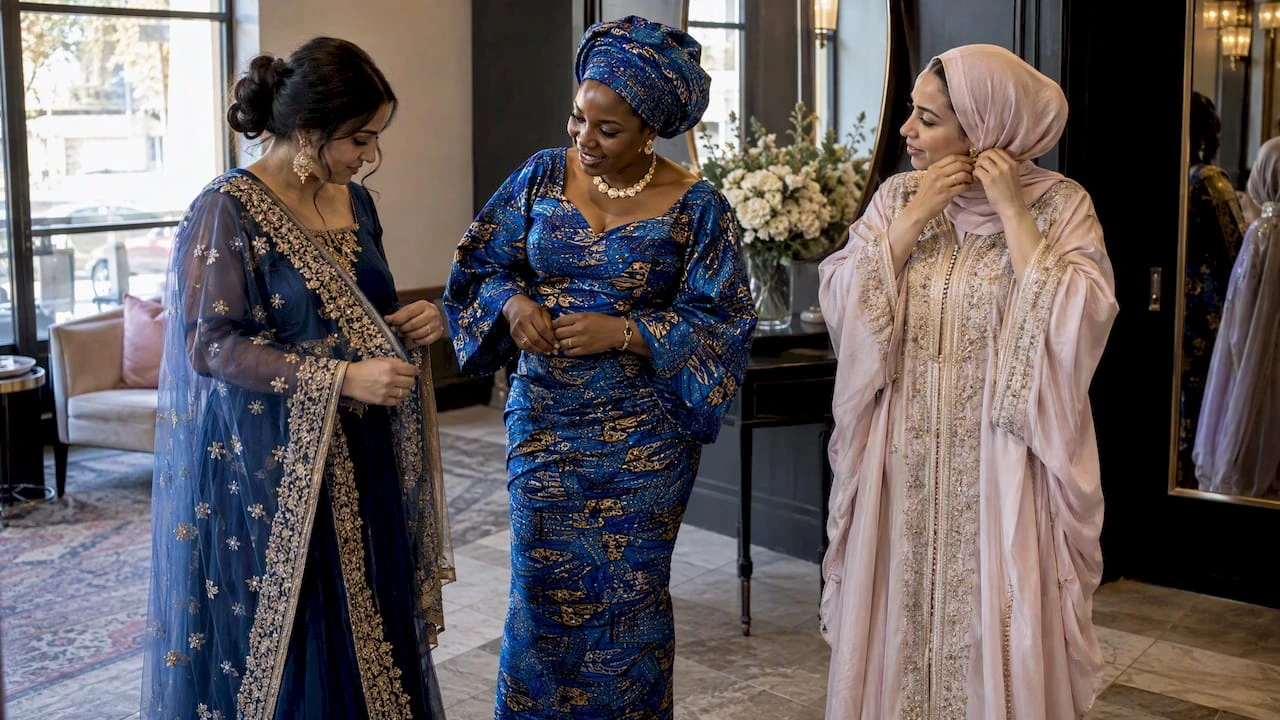
Every region carries its own silhouette language, and understanding that language helps you choose something that feels intentional rather than borrowed at random. Here are five geo-cultural clusters with the visual cues worth knowing before you shop or style.
West Africa. Ceremonial dressing for weddings and royal events often centers on the George wrapper, a woven or embellished fabric tied at the waist, paired with a gele head tie folded into sculptural shapes. Among the Itsekiri people, ceremonial dress also includes the iborun shoulder cloth and coral beads, both of which signal status within weddings and royal ceremonies. Coral and royal blue or gold palettes dominate, and the overall effect reads as structured and intentional rather than draped loosely. If you want to echo this aesthetic respectfully, work with a seamstress on a wrapper-style skirt in a bold print, paired with a tailored top, and skip the coral beadwork unless you understand its ceremonial weight.
South Asia. The sari, lehenga, and salwar kameez each offer a different formality level. A sari drapes as a single long fabric with pleats and a pallu thrown over one shoulder; a lehenga pairs a fitted blouse with a full skirt; a salwar kameez combines loose trousers with a tunic and dupatta scarf. Heavy embroidery such as zari thread work or mirror embellishment signals formal or bridal wear, while simpler cotton versions suit daytime events. Dupatta draping alone, pinned at the shoulder over a Western gown, is a wearable way to nod to the tradition without replicating the full ensemble.
East Asia. The hanbok’s structure matters more than any single motif. UNESCO documents the hanbok as a jacket paired with a woman’s skirt or a man’s trousers, traditionally made from silk, ramie, or cotton, with wearing knowledge and accessories passed down within families and communities. That transmission detail matters for inspiration seekers: a hanbok worn to a milestone birthday may look different from one worn at a wedding, so asking a host or local source about context beats guessing. Background on the culture behind the garment, including social customs tied to Korean dress traditions, can help frame why the structure stays consistent even as fabric and color shift by occasion.
North Africa and the Middle East. The caftan, gandoura, and melehfa each carry ceremonial weight. UNESCO’s record on Eastern Algerian ceremonial costume describes embroidered fabrics, brooches, belts, and headwear tied closely to ceremony and craft transmission. A caftan silhouette, loose and floor-length with a fitted waist tie, adapts well to formal events and offers built-in modesty coverage. The respectful move here is choosing simple embroidery over replicating specific brooch or belt arrangements that carry ceremonial meaning you have not researched.
Northern and European folk and formal wear. Embroidered tailored coats, wool and linen fabrics, and heirloom pieces define this cluster. These garments often pair structured outerwear with natural fiber skirts or dresses, and the formality comes from tailoring precision rather than embellishment volume. A tailored coat dress with embroidered cuffs or collar references this aesthetic without copying a specific regional costume.
For each of these clusters, a few styling cues translate directly to shoppable choices:
- Choose structured waistlines and floor-length hems when the original garment is ceremonial, since shortening it changes the formality register.
- Match fabric weight to climate: heavier brocades and velvets for cooler formal events, lighter cottons and silks for warm-weather celebrations.
- Keep headwear simple unless you understand its specific meaning. Skip ceremonial crowns, veils, or sacred head coverings.
- Pair one statement element (a wrapper print, a dupatta drape, an embroidered cuff) with simpler modern pieces rather than layering several cultural references at once.
- Ask your tailor or stylist about movement: wrap skirts, pleated saris, and draped fabrics need practice walking and sitting before the event.
2. How to be respectfully inspired without appropriating
Cultural exchange and cultural appropriation sit on a spectrum, and the difference usually comes down to context, consent, and credit. Cambridge scholarship on fashion and intellectual property frames appropriation as context-dependent: borrowing that involves attribution, community involvement, and genuine intent reads differently than copying a sacred pattern for profit with no acknowledgment. There is no single global legal test for appropriation, but social harm, consent, and benefit sharing consistently shape whether a choice lands as respectful or extractive.
WIPO’s draft guidance on traditional cultural expressions recommends treating cultural inspiration as a research and relationship task rather than a styling decision made from a mood board. That means identifying who holds knowledge of a tradition, checking whether an element is sacred or restricted, and crediting any collaborators or source communities. A practical due-diligence process looks like this:
- Identify the tradition’s custodians, whether a specific community, region, or family lineage, and look for their own documentation or statements about the garment.
- Check whether the element you are drawn to is sacred, ceremonial, or restricted. WIPO guidance on Indigenous traditional cultural expressions warns that some expressions are not meant for public fashion use at all.
- When a motif is open to adaptation, prefer working with artisans from that tradition, commissioning pieces, or buying directly from makers rather than mass-produced copies.
- Credit the tradition publicly when you share photos, and consider how your purchase supports (or bypasses) the original makers.
A short list of red flags helps when you are unsure: sacred symbols used as decoration, commercial copying without any credit to the source community, and costume-like stereotyping that reduces a living tradition to a Halloween trope. Any of these should send you back to research rather than forward to checkout.
Pro Tip: When in doubt, ask the host or event organizer what they consider appropriate, since they often know the specific regional customs better than any general guide.
Dress and adornment communicate identity, ceremony, and social meaning well beyond the surface aesthetic. Penn Museum scholarship on the stories behind the clothes we wear
3. Styling mechanics for events: fabrics, tailoring, and movement
Getting the formality level right starts with fabric choice. Silk, velvet, and brocade read as formal because of how they catch light and hold structure, while cotton and linen tend to signal daytime or casual wear even in the same silhouette. That distinction affects both sourcing and cost: a brocade caftan or a silk sari blouse typically costs more and takes longer to source than a cotton version, so budget extra lead time if you are commissioning a formal piece.
Tailoring makes or breaks an inspired look. A few adjustments turn a casual silhouette into something event-ready, including adding lining to sheer fabrics, structuring the waist with a fitted panel or sash, choosing longer hems for formality, and opting for comfortable footwear to accommodate draped fabrics.
- Build in secure closures (hooks, snaps, or a well-placed belt) for wrap-style garments that need to hold through dancing or sitting.
Accessories carry their own rules. Jewelry often signals status within a tradition, so avoid stacking unfamiliar ceremonial pieces just because they look striking together. Headwear deserves particular care given how UNESCO documents wearing knowledge as something transmitted within families and communities rather than freely available to copy. When a wrap or belt method is part of the look, ask a tailor or a source familiar with the tradition to show you the technique rather than guessing. For travel and transport, fold embroidered or beaded pieces with tissue paper to prevent creasing, and pack a small repair kit separately from your main luggage.
One real-world example worth noting: say a silk brocade caftan costs more to commission than a cotton version and takes six weeks to complete versus two. That lead-time gap is the reason planning ahead matters more for formal, fabric-heavy looks than for simpler cotton pieces.
4. Event-ready planning workflow and checklist
A good cultural-inspired look needs a timeline, not a last-minute scramble. UNESCO’s documentation of Norwegian traditional costume offers a useful practice note: treat the garment as connected to the specific celebration and the wearing knowledge tied to it, which means planning around both the event and the tradition’s own expectations.
- Six or more weeks out: commission custom pieces from artisans, confirm fabric availability, and research the tradition’s wearing customs so you know what questions to ask your maker.
- Two to three weeks out: finalize rentals or custom tailoring, and book any alteration appointments for structured waistlines or hems.
- 48 to 72 hours before the event: do a final fitting, break in footwear, and pack a backup accessory in case a belt, brooch, or wrap fails.
- Day of: confirm host expectations one more time, pack an emergency kit with safety pins and stain wipes, and double-check that headwear or jewelry matches what you discussed with your source community or artisan.
Sourcing options each carry tradeoffs. Renting suits a one-time event and cuts cost but limits customization. Buying from an ethical artisan supports the tradition directly but needs the longest lead time. Commissioning a piece gives you the most control but requires the most planning. In-store alterations work well when you are adapting a ready-made formal dress with a cultural-inspired detail rather than building a full traditional garment from scratch.
5. History and significance behind the featured garments
Each garment in this guide carries history that shapes how it should be worn today. The hanbok’s structure, a fitted jacket with a flowing skirt or trousers, has been documented by UNESCO as part of Korean cultural heritage, with silk, ramie, and cotton marking different formality levels across generations. The gandoura and melehfa, ceremonial attires from Eastern Algeria, carry embroidery and accessory details that UNESCO ties directly to craft transmission and ceremonial context, meaning the same garment can look different depending on the specific ceremony it marks.
West African ceremonial dress built around the George wrapper and coral beads signals status within Itsekiri weddings and royal events, a tradition tied to family and community roles rather than a purely decorative choice. Across all these examples, the throughline is the same: garments carry meaning tied to family, fertility, status, and social roles, not just visual appeal, which is why understanding a piece’s background changes how you choose to wear it.
6. Tips for incorporating cultural dress elements into contemporary fashion
Blending cultural references into a modern outfit works best when you borrow structure rather than sacred symbolism. A dupatta draped over one shoulder of a simple gown, a wrapper-inspired print used for a cocktail dress skirt, or an embroidered cuff detail on a tailored coat all let you nod to a tradition without replicating a ceremonial ensemble piece for piece.

Pairing is the easiest lever. Keep one cultural element as the focal point and let everything else stay simple: a single statement fabric, one accessory, or one silhouette cue. Layering several unrelated cultural references at once tends to read as costume rather than considered style. If you are shopping ready-made pieces, look for designer collections that credit their cultural references openly, since that transparency usually signals a more thoughtful collaboration with the source tradition. Our own guide to exploring unique dress styles from different cultures walks through more specific pairing ideas if you want a deeper dive into blending silhouettes.
7. Considerations for gender-specific and non-binary cultural attire
Traditional dress codes often assign specific garments by gender, and that assignment carries real weight within a community even when it is not always visible to outsiders. The hanbok, for example, separates into a skirt pairing for women and trouser pairing for men within the same jacket structure, a distinction UNESCO records as core to the garment’s form.
For readers who identify outside the gender binary or want to dress in a way that does not strictly follow traditional assignment, the respectful approach is the same due-diligence process covered earlier: ask a source familiar with the tradition whether a silhouette can be adapted, and look for communities or designers who already offer non-binary interpretations rather than assuming a workaround. Some traditions have more flexibility in daily or festive wear than in strictly ceremonial contexts, so the event type matters as much as the garment itself. When no clear answer exists, choosing a simpler, non-gendered silhouette inspired by the tradition’s fabric and color palette, rather than a specific gendered cut, tends to be the safer route.

8. Common misconceptions and myths about cultural dress at events
One persistent myth is that any traditional-looking outfit is fair game as long as it is flattering. In reality, Cambridge scholarship on cultural appropriation in fashion shows that context, consent, and credit determine whether a choice reads as appreciation or appropriation, not the garment’s visual appeal alone.
Another misconception treats all elements of a tradition as equally available to borrow. Sacred symbols, ceremonial headwear, and restricted motifs carry different rules than everyday fabrics or general silhouettes, and conflating the two leads to avoidable missteps. A third myth assumes a single “authentic” version of a traditional garment exists. As the Norwegian and Korean costume records show, wearing customs shift by region, family, and occasion, so what looks correct in one context may miss the mark in another. Finally, some assume that paying for a garment automatically makes its use respectful. Purchase alone does not substitute for understanding the tradition. Buying from an artisan within the source community, crediting it publicly, and following known wearing customs matter more than the transaction itself.
9. Our approach to culturally inspired event dressing
We think about cultural inspiration the way we think about formalwear generally: fit, fabric, and context all have to work together. Balancing authenticity with the practical needs of event dressing, comfortable movement, appropriate formality, reliable tailoring, means we lean on research before we lean on trend. Ethical sourcing matters just as much as silhouette, which is why we point readers toward artisans and credited collections rather than guesswork. If you want more specific guidance, our expert tips for choosing a dress for cultural celebrations covers additional scenarios, and our styling team is always available for personalized questions.
— Dressmeup
Find your event-ready look in our curated collections
Once you know the silhouette, fabric, and formality level you want, the fastest path to an event-ready dress is our own catalog. We organize Evening Dresses by occasion and designer, which makes it easier to find a floor-length, structured silhouette that echoes the ceremonial shapes covered above without starting from scratch. For weddings with cultural elements, our Wedding Guest Dresses, Bridesmaid Dresses & Gowns category includes options with the modest coverage and formal tailoring many traditions call for.
If your event calls for a fuller ceremonial silhouette, browse Formal Gowns for floor-length structure, or check Quinceañera Dresses if you are dressing for that specific celebration. For cocktail-length or contemporary interpretations, our Cocktail Dresses, Designer Jumpsuits, Designer Mini Dresses collection offers lighter, shorter options that still nod to cultural fabric and print choices. Browse the collection that matches your event, and reach out to our styling support if you want help translating any of the looks above into something ready to wear.
FAQ
How can dress fashion be influenced by a culture?
A culture shapes fashion through its fabrics, construction methods, and the meanings attached to specific garments, like how UNESCO documents silk, ramie, and cotton as traditional hanbok fabrics tied to specific wearing customs. These influences travel into mainstream fashion through borrowed silhouettes, prints, and construction techniques, though the depth of that influence depends on whether designers credit and collaborate with the source community.
What is an example of cultural appropriation clothing?
A common example is using a sacred or ceremonial pattern, symbol, or headwear piece purely as decoration without crediting or consulting the community it comes from. Cambridge scholarship on fashion and intellectual property frames this as appropriation specifically when context, consent, and attribution are missing.
How do I know if a cultural dress element is sacred or restricted?
Start by researching the tradition’s own documentation, such as UNESCO heritage listings, and look for guidance from the community or region the garment comes from. WIPO’s guidance on traditional cultural expressions notes that some elements are simply not meant for public fashion use, so when in doubt, choose a non-sacred silhouette instead.
Does Dress Me Up NY sell traditional cultural garments?
We specialize in women’s formal and special occasion dresses, including evening gowns, wedding guest dresses, and Quinceañera styles, rather than traditional cultural garments themselves. Our collections work well for readers who want a formal silhouette inspired by a tradition’s structure, such as a floor-length draped gown or an embroidered formal dress.
What should I wear to a cultural event if I’m not part of that culture?
Research the specific tradition, ask the host about expectations, and choose either an appropriate formal outfit in the event’s dress code or a respectfully adapted, non-sacred silhouette. Our guide to choosing a dress for cultural celebrations walks through this decision in more detail.
Sources
- Decision: Custom of Korean costume — UNESCO
- Draft steps on traditional cultural expressions in fashion — WIPO
- Culture appropriation and the global fashion industry — Cambridge
- The stories behind the stories we wear — Penn Museum
Recommended
- Expert Tips for Choosing the Perfect Dress for Cultural Celebrations
- A Comprehensive Guide to Exploring Unique Dress Styles from Different Cultures
- Discover Unique Dress Styles for Your Next International Event
- Dress Code Explained 2025: A Guide for Special Events