
Formal Dress for Corporate Events: What to Wear
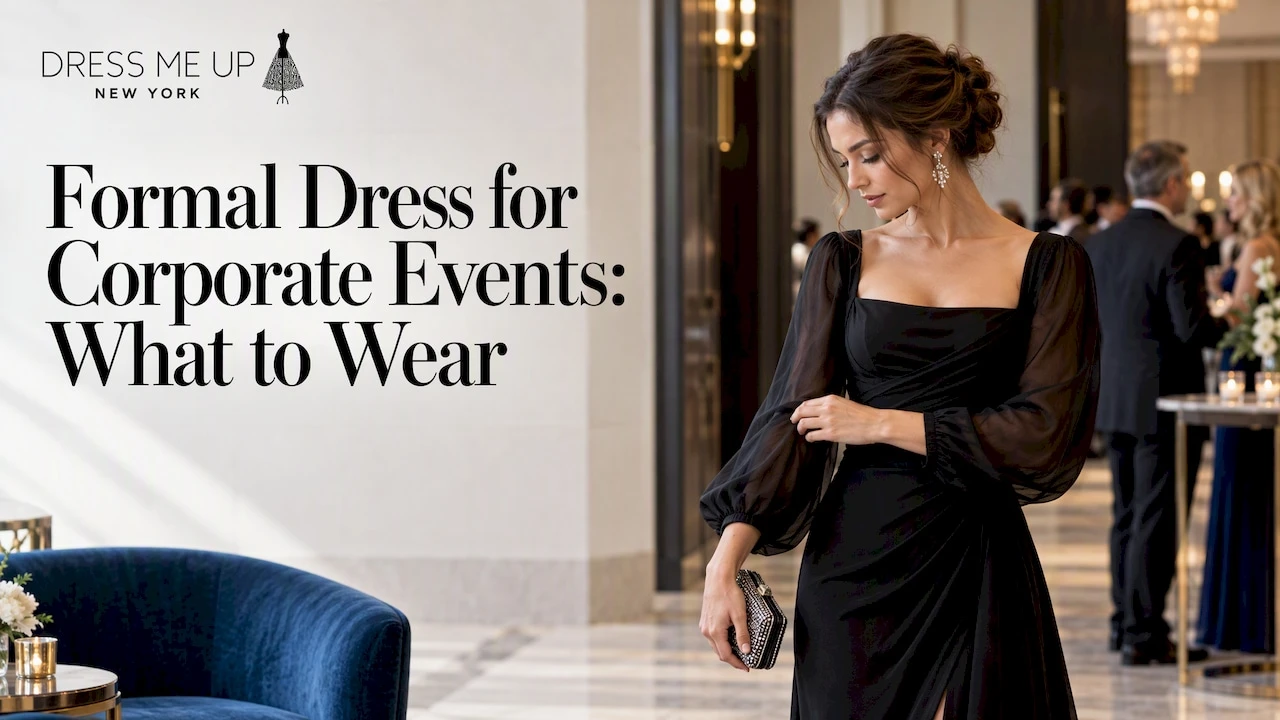
Formal Dress for Corporate Events: What to Wear

The right formal dress for a corporate event depends on the kind of event. For a conference, client meeting or pitch, choose a tailored, knee-length dress in a solid dark color, ideally with a jacket. For an evening gala or awards dinner, a floor-length gown with modest styling is the safe choice. Below, we walk you through how to tell which one you need, what to look for in a dress, and how to finish the outfit so you feel confident the moment you walk in.
TL;DR
- Daytime corporate events (conferences, client meetings, presentations) call for business formal: a tailored, modest dress or a dress with a jacket, usually knee-length.
- Evening corporate events (galas, awards dinners) are often black tie, where ankle- or floor-length is the standard.
- Solid black, navy, or camel, matte fabrics, and a clean fit read as professional almost everywhere.
- Skip sheer panels, plunging necklines, high slits, and loud prints. They draw attention away from you and your work.
- If the invitation is vague, ask the organizer, HR, or your manager. It takes one email and removes the guesswork.
Table of Contents
- What “formal” means at a corporate event
- Dress styles that work for corporate formal occasions
- Fabrics, colors, length, and fit
- Choosing your dress by event type
- Shoes, outerwear, and accessories
- What to do when the dress code is unclear
- Our perspective: polished doesn’t mean plain
- Shop smart and leave time for alterations
- Find your corporate formal dress with us
- FAQ
- Sources
What “formal” means at a corporate event
The word formal covers two very different looks, and mixing them up is the most common mistake. One is business formal, the dress code of boardrooms. The other is evening formal, the dress code of ballrooms. Both can show up on a corporate calendar, sometimes in the same week.
Business formal is the most formal tier of business attire. McMaster University’s dress-code guide places it at corporate networking events, conferences, awards events, presentations or pitches, interviews, and client meetings. For women, one event-planning guide describes it as a suit, a business-style dress, or a dress with a jacket.
Evening formal is a different animal. Washington State University’s apparel department separates professional formal from evening formal: professional formal keeps coverage restrained and styling workplace-appropriate, while an elaborate evening event calls for a very fancy full-length dress. The practical takeaway is that professional formal should project competence without making the body or the glamour the focus, and evening formal allows more elaborate garments.

The length gives you a quick cheat sheet. According to a corporate event dress-code guide, cocktail dresses are generally knee-length or just above the knee, while black-tie dresses are ankle- or floor-length. A sit-down banquet, awards dinner, or gala is usually black tie.
If you want a deeper look at the dress code itself, we cover it in our guide to the corporate formal dress code for professional women.
Dress styles that work for corporate formal occasions
You don’t need to give up personality to look professional. You just need to pick silhouettes that behave well when you sit, stand, shake hands, and stay in the room for several hours.
Sheath and shift dresses
These are the workhorses of business formal. A sheath follows your shape without clinging, and a shift skims it. Both look sharp on their own and even sharper under a blazer. Pick a high enough neckline and sleeves (or a jacket to add them) and you are set for a pitch or panel.
A-line and fit-and-flare dresses
If a pencil silhouette feels restrictive, an A-line gives you room to walk and sit comfortably while still looking structured. Keep the hem at or just below the knee for daytime. This shape is a great pick for long conference days.
Dress-and-jacket sets
A matching or coordinated jacket turns almost any simple dress into business formal. It also solves the shoulders question: one workplace dress-code handbook from the Philippine government advises that tops cover the shoulders or be worn under a blazer, and the same logic applies to dresses.
Modest evening gowns
For black-tie corporate dinners, a long gown with sleeves, a clean neckline, and a structured fabric lets you honor the dress code and the setting at once. If that is the direction you are heading, our pieces on modest evening gowns and timeless modest gowns for any party dress code show how to get glamour without the risk.
Cocktail dresses for the in-between events
Some corporate receptions, client dinners, and holiday parties land between business formal and black tie. A refined cocktail dress, knee-length and in a rich solid color, handles those nicely. You can browse options in our cocktail dresses collection.
For more on style choices, see our full guide on dress styles that work for corporate formal occasions.
Fabrics, colors, length, and fit
Three quick rules cover most situations: a classic color, a fabric with some structure, and a length that works when you sit down.
Color
For conferences and meetings, the Philippine handbook prefers solid neutrals such as black, navy, or camel, in clothing that is well pressed and free of heavy or distracting patterns. A Reddit thread in a business-fashion community on dresses for a formal business gala reached a similar conclusion: black or navy is a reliable choice.
That doesn’t mean you have to live in black. Deep jewel tones like emerald, burgundy, and midnight blue read just as polished, particularly in the evening. Save bright or pastel shades for events where the tone is celebratory rather than a high-stakes presentation.
Fabric
Look for fabrics that hold their shape and resist wrinkles: crepe, ponte, structured satin, wool blends, and thicker matte stretch weaves. Avoid anything clingy, shiny in a nightclub way, or sheer. The same handbook points to cotton or wool blends for pencil and A-line skirts. For evening, a guideline on “After Five” events from a national organization’s dress-code document advises avoiding see-through fabrics, bodice cut-outs, plunging necklines, and backless dresses. That is a good checklist for corporate evening wear in general.
Length
For daytime, the standard is simple: the handbook says work dresses should be long enough to sit comfortably, with skirts reaching at least the top of the knees. Try this test at home: sit on a chair, cross your legs, and check where the hem lands. For evening, an Ohio Northern University guide says a floor-length evening gown is most appropriate for formal black-tie work functions, and that a knee-length dress can be acceptable if it is not too revealing.

Fit
A good fit does more for your look than any label. You want room to raise your arms, lean toward a laptop, and walk quickly between sessions. If the dress pulls at the bust or hips, size up and have it tailored. A university career center notes that professional attire should be wrinkle-free and well groomed, so steam it the night before.
We go deeper on this in fabrics, color, fit and the rules that make a dress read professional.
Choosing your dress by event type
Here is a quick way to match the event to the outfit. Treat it as a starting point, then adjust to your industry and the invitation.
| Event | Typical dress code | Dress that works | Length |
|---|---|---|---|
| Conference or panel | Business formal | Sheath or A-line in navy, black, or camel, with a blazer | At or just below the knee |
| Client meeting, pitch, presentation | Business formal | Tailored dress with a jacket, or a dress-and-jacket set | Knee-length |
| Networking reception | Business formal to cocktail | Refined cocktail dress, matte fabric, covered shoulders | Knee-length |
| Awards ceremony | Cocktail or black tie | Polished cocktail dress or a modest long gown | Knee to floor |
| Gala or sit-down banquet | Black tie | Floor-length gown with a clean neckline | Ankle or floor |
| Virtual conference | Business or business casual | Solid dress or top and jacket, professional head to toe | Camera-ready |
On virtual events, one conference attire guide suggests choosing business or business casual depending on the event’s tone. Solid colors tend to look cleaner on camera than busy prints.
If you are shopping for a gala, our formal gowns are a good place to start. For a deeper walk-through of each scenario, see how to choose your dress by specific event type.
Shoes, outerwear, and accessories
The dress gets the attention, but the finishing touches signal that you understood the occasion. Style coach Nikki Venus, quoted in Vogue’s guide to formal attire, says polished accessories communicate respect and awareness of the occasion, not just that you look nice.
Shoes
- Daytime business formal: closed-toe pumps, sling-backs, dressy flats, or low wedges. The Philippine handbook calls closed-toe shoes with heels of roughly 0.5 to 3 inches advisable, which also keeps you comfortable across a long day.
- Evening black tie: the “After Five” guideline lists dress heels, dressy flats, or strappy heels. Vogue adds stilettos, polished flats, and kitten heels as formal options.
A tip we love: wear the shoes for at least an hour at home before the event. Blisters have ended more networking evenings than bad small talk.
Outerwear and layers
A dressy cardigan, shawl, or jacket complements a formal outfit, according to the same “After Five” guideline. Conference rooms run cold, and a tailored blazer or wrap also covers bare shoulders if you are wearing a sleeveless dress.
Bags and jewelry
Vogue suggests a clutch or small top-handled bag that matches the event’s elegance. For daytime, a structured tote or slim portfolio works. Keep jewelry simple: stud earrings, a delicate necklace, a watch. The handbook recommends conservative, tasteful accessories and simple bags.
Hosiery
If your dress or skirt suit calls for it, a university business-attire guide advises wearing hosiery in a basic sheer color without patterns. It is an old-school rule, but in conservative industries it still matters.
More finishing ideas, plus emergency fixes, are in shoes, outerwear, accessories and day-of fixes.
What to do when the dress code is unclear
Invitations love vague phrases like “professional attire” or “dressy.” Here is how to decode them without stress.
- Read the whole invitation. Look at the time of day, venue, and activities. The corporate event guide we mentioned earlier says the formality of the occasion and the activities should guide your choice.
- Ask. Career advice from SEEK says to check workplace policy and invitation details, or ask a manager or HR when the code is unclear.
- Consider your industry. McMaster’s guide treats business formal as one point on a broad spectrum, and says to weigh the situation, the stakeholders, and whether your sector is traditionally conservative or progressive. Finance and law lean traditional. Creative and tech lean looser.
- When in doubt, dress one notch up. Elizabeth Conway, quoted by The Muse, notes that getting the dress code wrong is more conspicuous in a professional setting than a social one. A jacket you can take off is easier than a jacket you wish you had.
Our article on what business formal actually means and how to read the invite offers more phrase-by-phrase examples.
Our perspective: polished doesn’t mean plain
We spend our days helping women find dresses for some of the biggest nights of their lives, and corporate events come up more than people expect. Our view is simple: the best corporate dress is the one you stop thinking about after the first five minutes.
That means choosing a cut that fits you properly, a color you feel good in, and details that are quiet rather than loud. A beautifully tailored dress in deep navy with a good jacket will serve you at a conference, a client dinner, and a year-end celebration. A clean, modest gown with sleeves will carry you through a black-tie awards night without a second of worry.
We also believe in planning ahead. Order early, try everything on, and leave time for a tailor, because a small hem or waist adjustment is often the difference between “nice dress” and “that looks made for you.” Our catalog is organized by event, designer, and style so you can narrow things down quickly, and our team is happy to help if you are unsure what an invitation is asking for.
— Dressmeup
Shop smart and leave time for alterations
A few habits make shopping for a corporate dress much easier:
- Start with the event, not the dress. Know the dress code, time of day, and venue first.
- Check the length in motion. Sit, stand, climb stairs. A hem that rides up is a problem at hour three.
- Choose a color you can reuse. Navy, black, and deep jewel tones work across events.
- Order early. You want time for returns, exchanges, and tailoring.
- Plan the whole outfit. Shoes, bag, and a layer should be decided before the dress arrives.
For a longer checklist, see how to shop smart and build in time for alterations, or read the full formal dress for business events guide.
Find your corporate formal dress with us
If you have a gala, awards dinner, or formal reception coming up, our evening dresses and formal gowns are organized by event and style, so you can get to the right options fast. Attending a wedding-adjacent company celebration? Take a look at our wedding guest dresses too. Our team can help you narrow things down if you are not sure where to start.
FAQ
Is a dress appropriate for business formal?
Yes. Business formal for women includes a suit, a business-style dress, or a dress with a jacket. Choose a tailored, modest cut in a solid, darker color, with a hem at or below the knee, and add a blazer for extra polish.
What length should a dress be for a corporate event?
For daytime events, knee-length or just below is the safest. For black-tie evening events, ankle- or floor-length is the standard, though a knee-length dress can be acceptable if it is not too revealing. Whichever length you choose, make sure you can sit comfortably.
What color is best for a corporate formal dress?
Solid black, navy, and camel are the most dependable for conferences and meetings. Deep jewel tones work well for evening events. Avoid heavy or distracting patterns and anything too bright for high-stakes daytime settings.
Can I wear a cocktail dress to a corporate event?
Often, yes, especially at receptions, client dinners, and cocktail-attire evenings. Keep it knee-length, in a matte fabric, with covered shoulders or a jacket. If the event is black tie, step up to a floor-length gown.
What if the invitation doesn’t state a dress code?
Ask the organizer, HR, or your manager, and consider the time of day and the venue. If you cannot get an answer, dress one step more formal than you think you need and bring a layer you can remove.
Sources
- Corporate Event Dress Code: How to Decide What’s Right
- Navigating Dress Codes (McMaster University)
- Professional Formal (Washington State University)
- How to Dress for a Formal Corporate Event
- Dress Code Handbook (Philippine government)
- How to Dress for “After Five” Events
- Professional Dress for Men & Women (Ohio Northern University)
- Business Attire Guide (Gardner-Webb University)
- Owl Professional Clothes Closet Guide (Florida Atlantic University)
- The Vogue Guide to Formal Attire
- Navigating Conference Attire: A Guide for Women
- Smart Business Attire: Dressing for Success (SEEK)
- Work Event Dress Codes Decoded (The Muse)